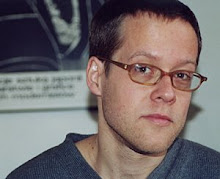
I arrived at the Four-faced Liar, a darkened bar on 4th St., where a small group of reader-listeners sat in round-table format. I was a half-hour too late to hear Jonathan Mayhew. We had the place to ourselves. Jordan read as teenage skaters gathered outside the open doorway, oblivious of the nearby poetry. They smoked awkwardly and unintentionally added lines to his work:
“let’s go find an ATM machine”
“you have a hole in your pants”
“I don’t have any money for a cab”
These fluid and concise intimations of penury fell not unevocatively into Jordan’s poems, one of which took as its point of departure the character of a put-upon employee of a large financial institution. Name: Ira. The rattling of their skateboards did, however, disrupt things a bit, and between poems our host and bartender, Shafer Hall stood with folded arms at the doorway, and, Lord of The Rings-like, banished the assembly to some unknown quarter of the West Village with a single glance.
Jordan:
“an avalanche of repair gnomes”
“so much of life is practicing gestures”
“a great chain of ability stretching back to chimps”
After I talked cymbals with Jonathan a bit, and caught up by reading from his printout some of the poems I had missed. Caught up with Douglas, who was down from Albany, and we all headed west to meet Katie, walk in the sunlight and gaze upon indoor mountain ranges of salt.
4.18.2005
Booklet and listening session for the Music and Poetry #2:
Read aloud two short poems:
Laura Riding, Cure of Ignorance
Ted Berrigan, She
Compared the vocabulary registers of these poems, degree of repetition, and overall mood from a chordal perspective. "vertical playing" in poetry. Tension and relaxation.
Andrey Bely, The Dramatic Symphony
Applying musical structure to writing on the level of the phrase unit as well as the long term use of image and thematic repetition. Satire. Layering.
David Toop, Ocean of Sound
Genre-defying in critical prose. History and sensation. Using the mass of recorded music and literature as a kind of creative space.
Herman Helmholtz, On the Sensations of Tone
Inseparability of science and art. Psychoacoustics and difference tones.
Played:
Sun Ra, Nuclear War
Archie Shepp, Malcolm, Malcolm,-Semper Malcolm
Will Alexander "A National Day in Bangladesh"
Read aloud two short poems:
Laura Riding, Cure of Ignorance
Ted Berrigan, She
Compared the vocabulary registers of these poems, degree of repetition, and overall mood from a chordal perspective. "vertical playing" in poetry. Tension and relaxation.
Andrey Bely, The Dramatic Symphony
Applying musical structure to writing on the level of the phrase unit as well as the long term use of image and thematic repetition. Satire. Layering.
David Toop, Ocean of Sound
Genre-defying in critical prose. History and sensation. Using the mass of recorded music and literature as a kind of creative space.
Herman Helmholtz, On the Sensations of Tone
Inseparability of science and art. Psychoacoustics and difference tones.
Played:
Sun Ra, Nuclear War
Archie Shepp, Malcolm, Malcolm,-Semper Malcolm
Will Alexander "A National Day in Bangladesh"
4.14.2005
4.13.2005
Photocopy booklet and listening session for the first Music and Poetry class:
Emily Dickinson, 1315: poly-tonal on a cognitive level, concision.
Thoreau, selected Journal entries on sound: interdependent notes on sound world, environment and poetic thought.
Joscelyn Godwin, Acoustics, from The Mysteries of the Seven Vowels: The partial series, voice as instrument, vowels and words as musical tones. Listening and identifying acoustics as complex musical information processing.
Kamau Brathwaite, selection from Barabajan Poems: personal jazz archeology/autobiography. Discovering music in context, interweaving of expository writing on music, poetry, autobiography.
Played for class:
Arnaut Daniel, Chanson Do.Ill Mot Plan E. Prim from Troubadour songs, Lyrichord Discs,1994. Translated by Kenneth Koch
Satisfaction, Music by Vitold Rek, lyrics by John Tchicai, from Saisfaction, Enja, 1992
Emily Dickinson, 1315: poly-tonal on a cognitive level, concision.
Thoreau, selected Journal entries on sound: interdependent notes on sound world, environment and poetic thought.
Joscelyn Godwin, Acoustics, from The Mysteries of the Seven Vowels: The partial series, voice as instrument, vowels and words as musical tones. Listening and identifying acoustics as complex musical information processing.
Kamau Brathwaite, selection from Barabajan Poems: personal jazz archeology/autobiography. Discovering music in context, interweaving of expository writing on music, poetry, autobiography.
Played for class:
Arnaut Daniel, Chanson Do.Ill Mot Plan E. Prim from Troubadour songs, Lyrichord Discs,1994. Translated by Kenneth Koch
Satisfaction, Music by Vitold Rek, lyrics by John Tchicai, from Saisfaction, Enja, 1992
4.12.2005
Solution Passage rears its head again:
"I hate things on the floor
I don't cotton to being
that far above a world"
"I hate things on the floor
I don't cotton to being
that far above a world"
4.10.2005
Sasha Frere-Jones, Slow Fade, The Afterlife of an Indie Band, The New Yorker
So many stock moves of rock criticism -- defensive hipsterism, genre-attachment bigotry and fashion displays -- move the writing away from insight, much in the same way that stock poetry maneuvers -- strained analogy and awkward sentimentality -– move poetry away from the life information that the writing is ostensibly engaging.
The poets represented in the New Yorker should study the Frere-Jones column, and see what happens when you use analogy as a technology for approaching insight, rather than for repeating pro-forma sentimental gestures.
"The problem was that Slint did not create a simple, easily imitated beat like Bo Diddley, or an elemental song like the Sex Pistols’ "Anarchy in the U.K.," which anyone could learn to play. Slint—or "Spiderland," because the two had become interchangeable—was like that grilled-cheese sandwich bearing the face of the Virgin Mary: an unlikely and irreproducible marvel."
I’ve never read a simile in a poem in the New Yorker with anywhere near this level of commitment to getting the linguistic construction to unpack social information.
He zigzags through setting up the context of the music, subjective impressions of it, descriptions of song structures and the element and personalities involved in the Slint story. Steve Albini is compared to Clement Greenberg.
To round out the interweaved layers here, he adds this:
For six minutes, the track inched along until—in one of the evening’s few traditional rock moments—it exploded with two enormous, distorted chords, each separated by tiny pauses, as McMahan screamed, "I miss you!" The words seemed, in the context of the show, to be a proxy for all the stuff that boys don’t talk about: that excruciating weekend with your new stepfather; that scary walk in the woods; that rift with your best friend, whom you haven’t seen in years.
So many stock moves of rock criticism -- defensive hipsterism, genre-attachment bigotry and fashion displays -- move the writing away from insight, much in the same way that stock poetry maneuvers -- strained analogy and awkward sentimentality -– move poetry away from the life information that the writing is ostensibly engaging.
The poets represented in the New Yorker should study the Frere-Jones column, and see what happens when you use analogy as a technology for approaching insight, rather than for repeating pro-forma sentimental gestures.
"The problem was that Slint did not create a simple, easily imitated beat like Bo Diddley, or an elemental song like the Sex Pistols’ "Anarchy in the U.K.," which anyone could learn to play. Slint—or "Spiderland," because the two had become interchangeable—was like that grilled-cheese sandwich bearing the face of the Virgin Mary: an unlikely and irreproducible marvel."
I’ve never read a simile in a poem in the New Yorker with anywhere near this level of commitment to getting the linguistic construction to unpack social information.
He zigzags through setting up the context of the music, subjective impressions of it, descriptions of song structures and the element and personalities involved in the Slint story. Steve Albini is compared to Clement Greenberg.
To round out the interweaved layers here, he adds this:
For six minutes, the track inched along until—in one of the evening’s few traditional rock moments—it exploded with two enormous, distorted chords, each separated by tiny pauses, as McMahan screamed, "I miss you!" The words seemed, in the context of the show, to be a proxy for all the stuff that boys don’t talk about: that excruciating weekend with your new stepfather; that scary walk in the woods; that rift with your best friend, whom you haven’t seen in years.
4.07.2005
Kit Robinson, Poetry Project, 4/6/05
"in poetry, you are given all the letters and have to arrange them yourself"
Quick, fluid crosshatching of seamless, interdependent layers built up into a kind of resonant image -- speech rhythm, overheard phrases, re-contextualized parts of language, recorded thought and sensation evoked with a minimum of words.
"the inhabitation of a weird head" -- poetry as escape into someone else’s head…or into one's own.
On the page, Robinson’s line energy might suggest a subdued delivery, but he has a lot of forward momentum live, without sacrificing any of the nuances of inflection.
Checking one’s own wakefulness on a micro-scale.
"Hundreds of thousands of email messages gone forever." -- the sense of the ephemeral…
"writing goes it’s own way -- you have to supply the synthesis" Like Morton Feldman’s "don’t push the tones around, let them be."
The work has a feeling of providing much information about life – about the social environment and the environment of the mind -- while supplying very few details. Listening to it, you can feel the data decompressing. The flexible and evocative qualities of language are used as a bridge across contexts, gaining resonance and impact from the spaces of daily human ephemeral life that would normally go unmentioned. In this sense this is a dynamic Zen poetry.
"play scales, watch for whales."
"in poetry, you are given all the letters and have to arrange them yourself"
Quick, fluid crosshatching of seamless, interdependent layers built up into a kind of resonant image -- speech rhythm, overheard phrases, re-contextualized parts of language, recorded thought and sensation evoked with a minimum of words.
"the inhabitation of a weird head" -- poetry as escape into someone else’s head…or into one's own.
On the page, Robinson’s line energy might suggest a subdued delivery, but he has a lot of forward momentum live, without sacrificing any of the nuances of inflection.
Checking one’s own wakefulness on a micro-scale.
"Hundreds of thousands of email messages gone forever." -- the sense of the ephemeral…
"writing goes it’s own way -- you have to supply the synthesis" Like Morton Feldman’s "don’t push the tones around, let them be."
The work has a feeling of providing much information about life – about the social environment and the environment of the mind -- while supplying very few details. Listening to it, you can feel the data decompressing. The flexible and evocative qualities of language are used as a bridge across contexts, gaining resonance and impact from the spaces of daily human ephemeral life that would normally go unmentioned. In this sense this is a dynamic Zen poetry.
"play scales, watch for whales."
4.03.2005
Saw the colorized version of the Bollywood classic Mughal-e-Azam at the Imaginasian theater after last minute heads up from Sandhya. Arrived a half hour early to excited party vibe in lobby, wine and cheese, video interviews etc. Filed in early, used to NYC competition for seat real estate. The early crowd was pushed to the back of the theater, rather than middle, the reason for which became clear soon enough: the volume of the film was the loudest I'd ever heard, rock club loud. Pulled out my spare earplugs.
The Prince's love of a handmaid dancer threatens King/father's (Rumsfeld?) military dictatorship succession plans. Love threatens class structure. Does this translate to: amorous love = working class power? Familial love = authoritarian power?
Mainly developed into the prince's power struggle with his remote, absentee father who values social power over love. Also -- reaction against arraigned marriage? The affect of the love affair is intense, but it is left without any substance or development, not so the father/son dynamic.
Crazy combination of vibes: like a Disney / Busby Berkeley / Ken Russell collaboration with a soundtrack provided by Ravi Shankar/Butthole Surfers. Insane and beautiful and poetic and odd.
Strangely two-dimensional three dimensional spaces of the sets, like a video game or a pop-up book. Extremely psychedelic colors.
Increasing intensity of affect from actors using, cartoon-like melodramatic set-ups. The father king's neck swells up like a frog when overcome by rage, which is often.
The Prince is introduced as a warrior/poet, complete with frilly feather pen, but the poet thread is dropped from the character. The figure of the sculptor who introduces the dancer handmaid into the picture knowing the Prince's love for her will be a creative subversion of the authoritarian social structure he hates. We know the Prince is not truly subversive, or else he would flee with the dancer and give up power. The sculptor (director?) is the one reacting against an imbalance in the social order.
Interesting, persistent sound textures throughout the soundtrack. Constant ringing of ankle bells reminds the audience of the corporeality of the actors apart from the drama. Chains dragged across surfaces -- the inflexibility and inhumanity of oligarchy.
Beautiful sound moment outside during the Prince's execution scene. Outside but with an indoor-sounding small-room reverb. Exceedingly strange and compelling -- as though the outdoor public drama were taking place inside your head.
Crazy dance song sequences with poetry as lyrics -- corny, absurd, but also magisterial and with an odd intensity. Carl Dryer-grade close ups.
A few moments where still photos are used for shots -- the most amazing being the moment the dancer maid gives herself up to save the Prince -- time seemed to stop at that moment in the film, and even though the movie continues, there is a lingering feeling that time never re-started for this character, because the self-sacrifice for love was her defining moment of consciousness.
The movie ends on a reactionary note, though Gary says this has to do with attitudes about the family and the fact of censorship at the time....
Script shot through with poetic metaphor, and an intense feeling of fused dramatic arts increasingly felt as the dance /poetry song sequences build within the dramatic framing.
The Prince's love of a handmaid dancer threatens King/father's (Rumsfeld?) military dictatorship succession plans. Love threatens class structure. Does this translate to: amorous love = working class power? Familial love = authoritarian power?
Mainly developed into the prince's power struggle with his remote, absentee father who values social power over love. Also -- reaction against arraigned marriage? The affect of the love affair is intense, but it is left without any substance or development, not so the father/son dynamic.
Crazy combination of vibes: like a Disney / Busby Berkeley / Ken Russell collaboration with a soundtrack provided by Ravi Shankar/Butthole Surfers. Insane and beautiful and poetic and odd.
Strangely two-dimensional three dimensional spaces of the sets, like a video game or a pop-up book. Extremely psychedelic colors.
Increasing intensity of affect from actors using, cartoon-like melodramatic set-ups. The father king's neck swells up like a frog when overcome by rage, which is often.
The Prince is introduced as a warrior/poet, complete with frilly feather pen, but the poet thread is dropped from the character. The figure of the sculptor who introduces the dancer handmaid into the picture knowing the Prince's love for her will be a creative subversion of the authoritarian social structure he hates. We know the Prince is not truly subversive, or else he would flee with the dancer and give up power. The sculptor (director?) is the one reacting against an imbalance in the social order.
Interesting, persistent sound textures throughout the soundtrack. Constant ringing of ankle bells reminds the audience of the corporeality of the actors apart from the drama. Chains dragged across surfaces -- the inflexibility and inhumanity of oligarchy.
Beautiful sound moment outside during the Prince's execution scene. Outside but with an indoor-sounding small-room reverb. Exceedingly strange and compelling -- as though the outdoor public drama were taking place inside your head.
Crazy dance song sequences with poetry as lyrics -- corny, absurd, but also magisterial and with an odd intensity. Carl Dryer-grade close ups.
A few moments where still photos are used for shots -- the most amazing being the moment the dancer maid gives herself up to save the Prince -- time seemed to stop at that moment in the film, and even though the movie continues, there is a lingering feeling that time never re-started for this character, because the self-sacrifice for love was her defining moment of consciousness.
The movie ends on a reactionary note, though Gary says this has to do with attitudes about the family and the fact of censorship at the time....
Script shot through with poetic metaphor, and an intense feeling of fused dramatic arts increasingly felt as the dance /poetry song sequences build within the dramatic framing.
3.18.2005
3.17.2005
Great reading from Kasey last night at St. Mark's. Appropriated/ networked social word alchemy/comedic subversion.
Since thoughts and consciousness are types of networked computing, this is a kind of electronic social thought? The verbal materials are taken from the internet, and then changed-up in the mind-net. Very energized and funny, sweet but also demanding. Demanding that you be willing to try on a dozen different human perspective-goggles to dig it and check yourself at the same time. Kasey is insisting that these processes be a pleasure.
Signs from some of the older listeners, if I’m reading them right, that they are not understanding. I take this as a good sign:
How do you know if something is new? You don’t like it!
Since thoughts and consciousness are types of networked computing, this is a kind of electronic social thought? The verbal materials are taken from the internet, and then changed-up in the mind-net. Very energized and funny, sweet but also demanding. Demanding that you be willing to try on a dozen different human perspective-goggles to dig it and check yourself at the same time. Kasey is insisting that these processes be a pleasure.
Signs from some of the older listeners, if I’m reading them right, that they are not understanding. I take this as a good sign:
How do you know if something is new? You don’t like it!
3.16.2005
The thought of what America would be like if Robin Williams read Harry Matthews novels troubles my sleep.
3.14.2005
Brandon Downing and Steve Benson
St. Mark's Church, 3.9.05
Brandon Downing
“one of those muppets was feeding on me when I came to”
personality / fantasy / joke / push-pull theater
“greedy. I always come in 4th in poetry”
huh?--effects.
Stoned, splintered echos of private jokes.
An odd, tweaked poetic immobilization created by the simultaneous contradictory embrace of wacky, relaxed and likeable / nervous tense and uncomfortable.
Picking odd objects of appropriation (films, cartoons, commercials) and then using them privately to keep the poem in a state of dissociation. The effect a funny and friendly energy bending itself into a pretzel to avoid directly addressing the dirigible-scale questions about failures of communication that the whole thing sets into motion.
Affability with a strong undercurrent of anxiety.
Also, gleaner-mind seeing discarded culture as possible alternate fuel source?
Purina Cat Chow commercial slowed down until it became a nightmare.
The fact that Downing is showing cable access shows or forgotten cartoons about Paul Bunyan means that for him poetry is state of looking at things, not necessarily a sequence of words.
Steve Benson
Benson started with a sequence of questions from a new book. I had heard a version of this material before, when it was being written you could say. He generated it at a performance a few years ago at the Bowery Poetry Club. At the Poetry Project, he started with written questions, but then started to make up answers, and, I think, to make up new questions, departing from text. A method of entering the improvised performance. Pondering riffs, expressions of self doubt riffs . "Is this entire thing fatuous?" Riffing from the vocabulary. Chains of puns. Tense, torturous, hilarious, depressing, amusing. The best sequences were on topics of "insecurity" and "certainty." He crawled from word to word, clearly navigation the energy from individual word to individual word. How they branch in associations. Descriptions of mental states. The mind reeling against an unacceptable environment. Against itself. Against an uncooperative language. This was free association, adapted to the needs of performance art, not exactly free. And it is performance art. Not sure if it would work if he read it straight from the page, but it's great with the wandering around and tortured expression.
St. Mark's Church, 3.9.05
Brandon Downing
“one of those muppets was feeding on me when I came to”
personality / fantasy / joke / push-pull theater
“greedy. I always come in 4th in poetry”
huh?--effects.
Stoned, splintered echos of private jokes.
An odd, tweaked poetic immobilization created by the simultaneous contradictory embrace of wacky, relaxed and likeable / nervous tense and uncomfortable.
Picking odd objects of appropriation (films, cartoons, commercials) and then using them privately to keep the poem in a state of dissociation. The effect a funny and friendly energy bending itself into a pretzel to avoid directly addressing the dirigible-scale questions about failures of communication that the whole thing sets into motion.
Affability with a strong undercurrent of anxiety.
Also, gleaner-mind seeing discarded culture as possible alternate fuel source?
Purina Cat Chow commercial slowed down until it became a nightmare.
The fact that Downing is showing cable access shows or forgotten cartoons about Paul Bunyan means that for him poetry is state of looking at things, not necessarily a sequence of words.
Steve Benson
Benson started with a sequence of questions from a new book. I had heard a version of this material before, when it was being written you could say. He generated it at a performance a few years ago at the Bowery Poetry Club. At the Poetry Project, he started with written questions, but then started to make up answers, and, I think, to make up new questions, departing from text. A method of entering the improvised performance. Pondering riffs, expressions of self doubt riffs . "Is this entire thing fatuous?" Riffing from the vocabulary. Chains of puns. Tense, torturous, hilarious, depressing, amusing. The best sequences were on topics of "insecurity" and "certainty." He crawled from word to word, clearly navigation the energy from individual word to individual word. How they branch in associations. Descriptions of mental states. The mind reeling against an unacceptable environment. Against itself. Against an uncooperative language. This was free association, adapted to the needs of performance art, not exactly free. And it is performance art. Not sure if it would work if he read it straight from the page, but it's great with the wandering around and tortured expression.
3.11.2005
Autolux. Corecraft, Secret Machines
Irving Plaza, 3.7.05
Last minute Ave/ D bus bolt to Irving Plaza after a call from Alex of Prosolar Mechanics to check out Autolux.
Autolux is a trio. They knocked out appealingly noisy, introverted-but-social grooves made out of elements that were simplified at every turn. The tasty drummer held back her chops, using traditional grip. All of them were resisting complexity, or sneaking it in tiny micro-dilutions. You feel the invisible hand of complexity pressurizing the songs from the outside like homework you’re blowing off for now but intending to do. It's like the band was saying: "no, this is all you should need." I've been wondering when someone was going to pick up on the Sonic Youth side of the 80s historical blender we've apparently set to frappe. Here you go. They were literally looking at their shoes for the whole concert.
The songs were consistent. I think they suffered from opening band bad-mix-itous. not enough mid-to high end tonalities, too much bass, vocals too low. Listening to the CD would tell me more. Anytime they brought the higher guitar tones up, or doubled the vocals the whole horizon of the song would shift from quite good to great. I wish they had done more of this. I guess there is a kind of tacit agreement in certain bands to not think too much about structure and contrast, as a kind of perceived implicit resistance to certain social strucures? They brought their own Christmas lights mounted to cardboard squares. Does it seem insane to be from LA playing music like this?
Corecraft is a J. Mascis's group, a drummerless free-rock improv thing, more like something you might hear at ABC NO RIO at the Sunday night COMA series than Irving Plaza: bass, flute, slide guitar, guitar, tape loops.
I had listened to Dinosaur Jr. all through the 80s, esp. Bug and You're Living All Over Me, but had never seen them live. Mascis, with shocking, long, totally white-gray hair, sat for the whole set. His guitar tone, when it came to the surface for air, was piercing and rich. The sound man, big surprise, didn’t understand what to do with the flute.
Messy one-chord swells and ebbs. Everyone half-thinking about the other players, half trying to hold their own direction down no matter what. Mixed feelings about independance, competition, collaboration, and collectivity: it can be like that. There were maybe three swells which where marvelous -- stoner rock meets Phil Niblock. The high volume level brought out all the crazy undulating partial interactions in the drone. The ebbs were like places you have to go before you get to where you want to be -- musical bus stations, and too much of set consisted of this mode. If this band had a heavy drummer behind it, and sounded like the high moments the whole time, it would be mind-boggingly great.
I always get as much information about the music by turning around and reading the faces of the audience as I get from listening. I had no idea what to expect, since the audience here was way too young to remember Dinosaur Jr. I assumed they would hear this as an odd or laughable hippy stoner noise anomaly? What I saw was fatigue, yes, but also curiosity of a kind I don't always associate with rock shows. Sometimes the social style affiliation with bands shows itself as a closed off, competitive kind of excitement -- no trace of that left here, it had been erased. Also no bewilderment, which is what I expected.
Secret Machines light show was better than the music. I went home after the 2nd song.
Irving Plaza, 3.7.05
Last minute Ave/ D bus bolt to Irving Plaza after a call from Alex of Prosolar Mechanics to check out Autolux.
Autolux is a trio. They knocked out appealingly noisy, introverted-but-social grooves made out of elements that were simplified at every turn. The tasty drummer held back her chops, using traditional grip. All of them were resisting complexity, or sneaking it in tiny micro-dilutions. You feel the invisible hand of complexity pressurizing the songs from the outside like homework you’re blowing off for now but intending to do. It's like the band was saying: "no, this is all you should need." I've been wondering when someone was going to pick up on the Sonic Youth side of the 80s historical blender we've apparently set to frappe. Here you go. They were literally looking at their shoes for the whole concert.
The songs were consistent. I think they suffered from opening band bad-mix-itous. not enough mid-to high end tonalities, too much bass, vocals too low. Listening to the CD would tell me more. Anytime they brought the higher guitar tones up, or doubled the vocals the whole horizon of the song would shift from quite good to great. I wish they had done more of this. I guess there is a kind of tacit agreement in certain bands to not think too much about structure and contrast, as a kind of perceived implicit resistance to certain social strucures? They brought their own Christmas lights mounted to cardboard squares. Does it seem insane to be from LA playing music like this?
Corecraft is a J. Mascis's group, a drummerless free-rock improv thing, more like something you might hear at ABC NO RIO at the Sunday night COMA series than Irving Plaza: bass, flute, slide guitar, guitar, tape loops.
I had listened to Dinosaur Jr. all through the 80s, esp. Bug and You're Living All Over Me, but had never seen them live. Mascis, with shocking, long, totally white-gray hair, sat for the whole set. His guitar tone, when it came to the surface for air, was piercing and rich. The sound man, big surprise, didn’t understand what to do with the flute.
Messy one-chord swells and ebbs. Everyone half-thinking about the other players, half trying to hold their own direction down no matter what. Mixed feelings about independance, competition, collaboration, and collectivity: it can be like that. There were maybe three swells which where marvelous -- stoner rock meets Phil Niblock. The high volume level brought out all the crazy undulating partial interactions in the drone. The ebbs were like places you have to go before you get to where you want to be -- musical bus stations, and too much of set consisted of this mode. If this band had a heavy drummer behind it, and sounded like the high moments the whole time, it would be mind-boggingly great.
I always get as much information about the music by turning around and reading the faces of the audience as I get from listening. I had no idea what to expect, since the audience here was way too young to remember Dinosaur Jr. I assumed they would hear this as an odd or laughable hippy stoner noise anomaly? What I saw was fatigue, yes, but also curiosity of a kind I don't always associate with rock shows. Sometimes the social style affiliation with bands shows itself as a closed off, competitive kind of excitement -- no trace of that left here, it had been erased. Also no bewilderment, which is what I expected.
Secret Machines light show was better than the music. I went home after the 2nd song.
3.08.2005
Checked out some blogs on my friend Sandhya Jain's Blackberry 7100 cell phone yesterday. Loads at old 28.8 speeds, and breaks down the pages into a single little column. Nice color display.
Blogs with tons of links in left margin (Nick Piombino and Ron Silliman) don’t work well because you have to scroll through the links to get to the body text. The Jim Side comics were too small to read.
Jordan faired best -- fast load in and minimal link clutter to thumb scroll past -- not bad.
You could easily blog on this phone, which actually looks like a phone.
Blogs with tons of links in left margin (Nick Piombino and Ron Silliman) don’t work well because you have to scroll through the links to get to the body text. The Jim Side comics were too small to read.
Jordan faired best -- fast load in and minimal link clutter to thumb scroll past -- not bad.
You could easily blog on this phone, which actually looks like a phone.
Bonnie "Prince" Billy & Matt Sweeney. Kim’s downtown. Free in-store show. 3.5.05
A duet in a space not meant to be performed in. Music store consumer grid,isles flooded by 25-35ish scruffy hipsters, nobody going anywhere without a lot of trouble. I feel like an element of plaster poured into a mold.
No elevated stage or lights or forcing the audience to wait interminably to prove that the musicians are superior. The pleasantly envious and/or adoring goggling of the listeners (by gender?) from a power imbalance created partly by the appeal of the music, partly by the appeal of the indie-hero personas, not by the venue. The vibe is close to a house party, except everyone is uncomfortable.
Mountain music adapted to urban indie mind. Totally fluid fusion of elements. The opposite of the going NYC trend of purely gestural referencing / imitation of 80s music.
Though there may be a sardonic quality, it is not at all ill at ease with itself, as Beck is with his references. Mixed feelings flow undefensively, marvelously -- stylistic time made to twist over itself to create an image of the present.
A duet in a space not meant to be performed in. Music store consumer grid,isles flooded by 25-35ish scruffy hipsters, nobody going anywhere without a lot of trouble. I feel like an element of plaster poured into a mold.
No elevated stage or lights or forcing the audience to wait interminably to prove that the musicians are superior. The pleasantly envious and/or adoring goggling of the listeners (by gender?) from a power imbalance created partly by the appeal of the music, partly by the appeal of the indie-hero personas, not by the venue. The vibe is close to a house party, except everyone is uncomfortable.
Mountain music adapted to urban indie mind. Totally fluid fusion of elements. The opposite of the going NYC trend of purely gestural referencing / imitation of 80s music.
Though there may be a sardonic quality, it is not at all ill at ease with itself, as Beck is with his references. Mixed feelings flow undefensively, marvelously -- stylistic time made to twist over itself to create an image of the present.
Subscribe to:
Posts (Atom)