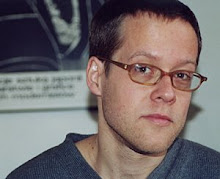
Ange Mlinko and Richard Hell,
St. Mark's Poetry Project, 10.26.05
Before the reading, I was struck by the beautiful crepuscular light of Soho -- the gigantic, uncanny face of Marvin Gaye hovering above Houston St. on a billboard.
Ange Mlinko
The strongest reading I've heard Ange give -- "transformation vs. encryption" -- family and memory -- Duchamp's Etant Donnes in the Philly art museum -- reacting with anger to the piece -- that the figure looked to her like a crime victim -- trying to remember a nightmare -- "an imagination which produces folklore and science alike." -- "Orpheus near store front"
Richard Hell
Hell started with twenty minutes of extemporaneous stories about being one of a couple of "knuckleheaded" punk kids hanging around the periphery of the 1970s St. Mark's poetry scene -- he followed this up with forty-five minutes of amateurish, sloppy, tedious fiction.
10.30.2005
10.27.2005
Dreamt that Jordan Davis and I were playing a game of chess, and in the first series of moves, all of our major pieces were mutually destroyed, leaving only pawns, kings and queens.
10.25.2005
Steve identifies the possibility of a new prose genre based on a the script of I Walked With a Zombie.
10.21.2005
My favorite moment of Juliana Spahr's reading at St. Mark's was a lovely, compelling list piece using all manner of species native to the area of Ohio where she grew up. These things were plugged into set phrases like "I let the (raccoon) into my heart, and "(crabapple), don't add to heartache." This localized, highly diffuse environmental information about Ohio (and really much of the northeast US) included poisons as well, "I let the (chloride) into my heart."
Another set phrase was "I didn't even say goodbye to (pumpkin)," where the implication is that a childhood connection to natural environment is gradually and unconsciously replaced by an adult social and sexual environment. The piece would almost fit into Technicians of the Sacred.
She introduced the poems as "sappy." This work did activate a simple, and, in a way, traditional mechanism of sentiment -- feelings associated with connection to the natural environment, but not at all of sentimentality -- displacing actual feelings with formalized, strategic clichés of feeling based on a projection of audience expectation. The poem was a kind of retrospective coming of age poem and environmental protest piece.
Another set phrase was "I didn't even say goodbye to (pumpkin)," where the implication is that a childhood connection to natural environment is gradually and unconsciously replaced by an adult social and sexual environment. The piece would almost fit into Technicians of the Sacred.
She introduced the poems as "sappy." This work did activate a simple, and, in a way, traditional mechanism of sentiment -- feelings associated with connection to the natural environment, but not at all of sentimentality -- displacing actual feelings with formalized, strategic clichés of feeling based on a projection of audience expectation. The poem was a kind of retrospective coming of age poem and environmental protest piece.
10.20.2005
Jennifer Moxley, Often Capital, Flood Editions, 2005
Two early serial poems.
The First Division of Labour:
Themes of partnership / work / love (and estrangement)
"desire returned as topiary"
The poem proceeds though an assembly of vocabulary and detail from a text we’re not necessarily privy to, transforming it, but without rorschaching the material, without rendering it’s interpretive horizon open-ended.
"The minor, graffiti / in / Atlantis"
Enlightenment Evidence:
Excess creativity in humans was possibly evolved as a result of sexual selection?
"Let sweetness be the creator of moments, building revolution / one kissing at a time."
The poet/speaker of this dramatic monologue associates her love life w/ a famous historical character and imbues this dramatic framework with political grandeur. Not a historical take on writing as straight documentary, but using history as cognitive reverb setting for one’s immediate situation. Something both Olson and Creeley do.
"the paramour trades beauty for silence"
Attachment to historical figures and amorous attachment. The problems of attachment -- Sorting through the significance of attachment through the filter of another text/aura -- sorting/attachment/association.
Two early serial poems.
The First Division of Labour:
Themes of partnership / work / love (and estrangement)
"desire returned as topiary"
The poem proceeds though an assembly of vocabulary and detail from a text we’re not necessarily privy to, transforming it, but without rorschaching the material, without rendering it’s interpretive horizon open-ended.
"The minor, graffiti / in / Atlantis"
Enlightenment Evidence:
Excess creativity in humans was possibly evolved as a result of sexual selection?
"Let sweetness be the creator of moments, building revolution / one kissing at a time."
The poet/speaker of this dramatic monologue associates her love life w/ a famous historical character and imbues this dramatic framework with political grandeur. Not a historical take on writing as straight documentary, but using history as cognitive reverb setting for one’s immediate situation. Something both Olson and Creeley do.
"the paramour trades beauty for silence"
Attachment to historical figures and amorous attachment. The problems of attachment -- Sorting through the significance of attachment through the filter of another text/aura -- sorting/attachment/association.
10.19.2005
10.17.2005
It finally stopped raining after a straight week of downpour. I thought I might never see sunlight again.
The mysterious repaving of the East Village continues with the top layer of many streets ripped up and left that way. The dust from the uprooted asphalt gets kicked up by the recent wind, making Ave. B look like the old west.
The mysterious repaving of the East Village continues with the top layer of many streets ripped up and left that way. The dust from the uprooted asphalt gets kicked up by the recent wind, making Ave. B look like the old west.
10.16.2005
The artist must have wanted this footage to be about the surveillance cameras, but the compelling thing about this fox loose in the National Portrait Gallery in London is that the fox is sleeping overnight in the museum. Looks like he found himself a comfy chair.
10.09.2005
Anselm Berrigan and Marianne Shaneen, Bowery Poetry Club, 10.8.05
Marianne Shaneen
Funny, information-rich poetry fused with a poetics of film.
She started with a sequence focused on, and wildly riffing off of, dolphins. Specifically the history of American... uh, use of Dolphins in covert operations. It was sloppy in a good way, that is it was Charles Mingus sloppy: with a relaxed open gangliness capable of accommodating a large amount of elements, all of which were allowed to act with a certain independence, while maintaining an upbeat overall forward momentum.
"The CIA was concerned about a looming 'Dolphin gap' with the Soviets."
"Wealth is a form of violence."
The second series was organized around themes of oil / petroleum, ranging over the politics of oil production, inescapable plastic based objects/ commodities, body fat, flensing boots etc.
We also heard about "cans of liquefied ravens and hawks" and "nostalgia for dinner table alienation"
The delivery was sometimes a little stumbling. With poetry this good, I couldn't help but think Marrianne should read through the work once or twice before getting on stage with it.
Language stretched across a historical, filmic membrane.
"Carl Marx stars as the Lone Ranger."
Anselm Berrigan
"regurgitation means birdie love"
The lines have a unique consistency and forward momentum. Almost every line has a high tensile strength, and therefore, the feeling of a certain weight, but the overall tempo and pacing moves with the kind effortless momentum that is normal accessed though a much lighter line strength.
"I know the bottled water isn't fooling anyone."
Beautifully interdependent language play and full-on subjective personal responsiveness embracing it's own ambiguities. This is as information-rich as Marrianne's poetry, but in a much differnt way, or using a different take on drama.
"Fear of looking normal but in fact being a wack-job"
Graceful, sinuous riff-switching between perception and declaration.
Marianne Shaneen
Funny, information-rich poetry fused with a poetics of film.
She started with a sequence focused on, and wildly riffing off of, dolphins. Specifically the history of American... uh, use of Dolphins in covert operations. It was sloppy in a good way, that is it was Charles Mingus sloppy: with a relaxed open gangliness capable of accommodating a large amount of elements, all of which were allowed to act with a certain independence, while maintaining an upbeat overall forward momentum.
"The CIA was concerned about a looming 'Dolphin gap' with the Soviets."
"Wealth is a form of violence."
The second series was organized around themes of oil / petroleum, ranging over the politics of oil production, inescapable plastic based objects/ commodities, body fat, flensing boots etc.
We also heard about "cans of liquefied ravens and hawks" and "nostalgia for dinner table alienation"
The delivery was sometimes a little stumbling. With poetry this good, I couldn't help but think Marrianne should read through the work once or twice before getting on stage with it.
Language stretched across a historical, filmic membrane.
"Carl Marx stars as the Lone Ranger."
Anselm Berrigan
"regurgitation means birdie love"
The lines have a unique consistency and forward momentum. Almost every line has a high tensile strength, and therefore, the feeling of a certain weight, but the overall tempo and pacing moves with the kind effortless momentum that is normal accessed though a much lighter line strength.
"I know the bottled water isn't fooling anyone."
Beautifully interdependent language play and full-on subjective personal responsiveness embracing it's own ambiguities. This is as information-rich as Marrianne's poetry, but in a much differnt way, or using a different take on drama.
"Fear of looking normal but in fact being a wack-job"
Graceful, sinuous riff-switching between perception and declaration.
10.07.2005
Robin Blaser & Etel Adnan, Poetry Project, 10.5.05
Etel Adnan
Details of everyday life set against a distant war felt as a kind of ever-present absence/force.
Welcome details of a late Steve Lacy concert.
"We are angry and you know what it means"
Robin Blaser
Funny to think The Holy Forest came out 12 years ago. Curious to see what the new U. Cal vers. is like.
Blaser looked the same as the last time I heard him - tweleve years ago in SF. I hope I age this well. He also read many of the same poems from the Holy Forest, so he must have favorites which haven't changed too much.
"Alien exotica," in classic tonality. The voicing and pacing very much like Robert Duncan. Ditto the play between the imagistic hinges, self-portraiture, historical references, and generally intense, expert, sprawling intellectual control over the materials. What differentiates it from Duncan is the Midwestern speech tones shot through, which are also my favorite element of this work.
"licking stones to improve their color"
The things that might, or, should, bother me about this poetry, the grandiose self-inflation, the pretentiousness, the too self-conscious mesmerism effects, don't for some reason. Because, I think, there is so much pleasure and range in this poetry. Because... that dude can write a poem!
"Your saxophone is by your bed / think of starlings / and their sharp quick sounds / goodnight."
Patterning of image / pun / setting / self-reflection /historical reference/ speech movement / image / etc.
"there is no future unless it be unpredictable"
The surface layer is romantic, but the underlying engine here is cybernetic -- events as information / information as events.
Identifying and going with complexity.
Etel Adnan
Details of everyday life set against a distant war felt as a kind of ever-present absence/force.
Welcome details of a late Steve Lacy concert.
"We are angry and you know what it means"
Robin Blaser
Funny to think The Holy Forest came out 12 years ago. Curious to see what the new U. Cal vers. is like.
Blaser looked the same as the last time I heard him - tweleve years ago in SF. I hope I age this well. He also read many of the same poems from the Holy Forest, so he must have favorites which haven't changed too much.
"Alien exotica," in classic tonality. The voicing and pacing very much like Robert Duncan. Ditto the play between the imagistic hinges, self-portraiture, historical references, and generally intense, expert, sprawling intellectual control over the materials. What differentiates it from Duncan is the Midwestern speech tones shot through, which are also my favorite element of this work.
"licking stones to improve their color"
The things that might, or, should, bother me about this poetry, the grandiose self-inflation, the pretentiousness, the too self-conscious mesmerism effects, don't for some reason. Because, I think, there is so much pleasure and range in this poetry. Because... that dude can write a poem!
"Your saxophone is by your bed / think of starlings / and their sharp quick sounds / goodnight."
Patterning of image / pun / setting / self-reflection /historical reference/ speech movement / image / etc.
"there is no future unless it be unpredictable"
The surface layer is romantic, but the underlying engine here is cybernetic -- events as information / information as events.
Identifying and going with complexity.
9.23.2005
Listening right now to WKCR, Phil Schaap playing the marvelous, pristinely recorded and unlikely quartet recording of Coltrane and Monk live at Carnegie Hall, 1957, due to be released by Blue Note on Tuesday. This recording was discovered buried in the Library of Congress. Great way to spend Coltrane's birthday.
9.15.2005
I waited in line for an hour in the rain to get free tickets to Jordan's Million Poems Show. Finally got in, pushed through the excited crowd, and nabbed a seat right next to Shanna. The crowd warmer, Jim Behrle, did some good preflight audience interviews, which he recorded, apparently, with a pack of Marlborough Lights.
I ran into Jordan just as the wardrobe person was getting his clip-on mic adhered to his tie. Jordan's talk show look/vibe is excellent: formal, friendly, a little nervous, slightly distanced but enthused and aiming to please. The suit says I care about my look, and the wrinkles say I don't care more than I should. He uses a Craig Kilborn-like posture on stage, but with none of the smugness. He's somewhere between Dick Cavett and Johnny Carson, leaning toward the Cavett side of the spectrum. The nervous part is in a good way -- he makes the audience and guests feel that they are important enough to get nervous over.
The opening monologue concerned the dangers of engaging in an interesting conversation with Ange Mlinko while trying to navigate in a car in upstate New York. Davis also touched on the surprising gaps in knowledge that can be found among the outlying population of Ithaca, NY as to where Ithaca actually is.
Jordan's house band, JJ Appleton, has a great theme song. If you even need to hear a catchy indie-pop talk show theme that addresses questions of what Jordan Davis dreams about, trust me, you're gonna want to get down there and check this out.
The first guest for the evening was Anselm Berrigan, a poet and Artistic Director of The Poetry Project. While Appleton played Elvis Costello's Less Than Zero, a winking reference to Berrigan's last book, Anselm hit the stage sporting a Macy's-looking button down striped shirt, cargo shorts and grey cross-trainers offset with black socks. The promoters over there at Edge Books are smart to get him out into the media early to start the buzz about his upcoming book, Some Notes on My Programming, which is gonna be big.
Anselm also read from an advance copy of The Ted Berrigan Collected Poems, which is slated for a November release from U. of California. The book is so large that many New Yorkers may have to knock down a wall to make room for it. I was concerned that it might throw Anselm off balance and into an unintended stage-dive. According to Anslem, there are hundreds of pages of work in this book that were never printed in any book. I figure if I can pre-order Halo 2, I can pre-order this.
I'm not usually one to complain, but there were some serious problems with Davis's musical guest, Leslie Mendelson. There is a tradition in singer/song writer performances done at poetry venues that one has to learn: 1) Sing out of tune and off-mic. 2) Have a weak sense of rhythm that feels like it's about to fizzle-out at any moment 3) Forget the song parts or lyrics and start over on at least one number, sheepishly apologizing. Mendelson simply ignored all of these time-honored traditions. She sang catchy 70s AM radio-like pop tunes in-tune and with a confident, appealing tone, crossing Carol King, Norah Jones and Randy Newman. If people just start throwing out the rules of our society like this, then anything goes, it would be total chaos. I guess if you want to break the rules of poetry-music, you could, but you first have to prove that you _know_ the rules. After a few years of paying your dues playing weak, wince-inducingly out of tune songs that just don’t work, then maybe you've earned the right to bend the rules _a little_ and perhaps sing in key. But to sing well in-key and to have the whole thing sound really good? This is just not how it’s done.
I ran into Jordan just as the wardrobe person was getting his clip-on mic adhered to his tie. Jordan's talk show look/vibe is excellent: formal, friendly, a little nervous, slightly distanced but enthused and aiming to please. The suit says I care about my look, and the wrinkles say I don't care more than I should. He uses a Craig Kilborn-like posture on stage, but with none of the smugness. He's somewhere between Dick Cavett and Johnny Carson, leaning toward the Cavett side of the spectrum. The nervous part is in a good way -- he makes the audience and guests feel that they are important enough to get nervous over.
The opening monologue concerned the dangers of engaging in an interesting conversation with Ange Mlinko while trying to navigate in a car in upstate New York. Davis also touched on the surprising gaps in knowledge that can be found among the outlying population of Ithaca, NY as to where Ithaca actually is.
Jordan's house band, JJ Appleton, has a great theme song. If you even need to hear a catchy indie-pop talk show theme that addresses questions of what Jordan Davis dreams about, trust me, you're gonna want to get down there and check this out.
The first guest for the evening was Anselm Berrigan, a poet and Artistic Director of The Poetry Project. While Appleton played Elvis Costello's Less Than Zero, a winking reference to Berrigan's last book, Anselm hit the stage sporting a Macy's-looking button down striped shirt, cargo shorts and grey cross-trainers offset with black socks. The promoters over there at Edge Books are smart to get him out into the media early to start the buzz about his upcoming book, Some Notes on My Programming, which is gonna be big.
Anselm also read from an advance copy of The Ted Berrigan Collected Poems, which is slated for a November release from U. of California. The book is so large that many New Yorkers may have to knock down a wall to make room for it. I was concerned that it might throw Anselm off balance and into an unintended stage-dive. According to Anslem, there are hundreds of pages of work in this book that were never printed in any book. I figure if I can pre-order Halo 2, I can pre-order this.
I'm not usually one to complain, but there were some serious problems with Davis's musical guest, Leslie Mendelson. There is a tradition in singer/song writer performances done at poetry venues that one has to learn: 1) Sing out of tune and off-mic. 2) Have a weak sense of rhythm that feels like it's about to fizzle-out at any moment 3) Forget the song parts or lyrics and start over on at least one number, sheepishly apologizing. Mendelson simply ignored all of these time-honored traditions. She sang catchy 70s AM radio-like pop tunes in-tune and with a confident, appealing tone, crossing Carol King, Norah Jones and Randy Newman. If people just start throwing out the rules of our society like this, then anything goes, it would be total chaos. I guess if you want to break the rules of poetry-music, you could, but you first have to prove that you _know_ the rules. After a few years of paying your dues playing weak, wince-inducingly out of tune songs that just don’t work, then maybe you've earned the right to bend the rules _a little_ and perhaps sing in key. But to sing well in-key and to have the whole thing sound really good? This is just not how it’s done.
9.08.2005
9.06.2005
9.03.2005
Can we just drop the facade of even having a federal government anymore? From now on, let's call it the American Oil War Corporation, AOWC. Their job is to take over oil-rich areas around the world to keep their profit margins high.
AOWC has been revising the taxation system to exclude services not related to Oil Wars. This increases productivity for the company. It's a private company, but it's paid for with public funds. The beauty of this system is that you can tax working poor and middle class people to pay for it. Think about it: why should oil millionaires be taxed to run their own Oil Wars? They created this business in the first place.
AOWC owns the National Guard now. There was a buyout. We sold it to them for a dollar. If you've been wondering where the National Guard has been in New Orleans, remember, AOWC's job is to kill people in other countries, not to rescue them in ours. Think about it, if you're too poor to escape a hurricane, it's doubtful that you're contributing much tax money to help fund the Oil Wars in the first place -- more likely you're unemployed, elderly, an infant, sick etc. -- i.e., not productive. So it's not a big deal for AOWC. Best to just let it go.
Needless to say, doing anything to keep entire American cities from being destroyed is not a part of AOWC's business plan, as it might have been with the old-fashioned Federal Government, even when the disaster was predicted as #1 of top ten possible disasters.
Did I mention that AOWC is a company guided by Christian values? Thank goodness those Christians in our country got out to vote for AOWC to prevent gay marriage. The scenes of totally obliterated society you're seeing on TV are the product of Christian values. Normally you only get to see scenes like this in big-budget Hollywood apocalyptic science fiction movies. The people at AOWC can make this shit real. Look at the footage of desperation and chaos in New Orleans and when the CEO of AOWC uses the word "Freedom," you'll now know what he's actually referring to. If you have a problem with any of this, remember: this is no time to talk about politics.
AOWC has been revising the taxation system to exclude services not related to Oil Wars. This increases productivity for the company. It's a private company, but it's paid for with public funds. The beauty of this system is that you can tax working poor and middle class people to pay for it. Think about it: why should oil millionaires be taxed to run their own Oil Wars? They created this business in the first place.
AOWC owns the National Guard now. There was a buyout. We sold it to them for a dollar. If you've been wondering where the National Guard has been in New Orleans, remember, AOWC's job is to kill people in other countries, not to rescue them in ours. Think about it, if you're too poor to escape a hurricane, it's doubtful that you're contributing much tax money to help fund the Oil Wars in the first place -- more likely you're unemployed, elderly, an infant, sick etc. -- i.e., not productive. So it's not a big deal for AOWC. Best to just let it go.
Needless to say, doing anything to keep entire American cities from being destroyed is not a part of AOWC's business plan, as it might have been with the old-fashioned Federal Government, even when the disaster was predicted as #1 of top ten possible disasters.
Did I mention that AOWC is a company guided by Christian values? Thank goodness those Christians in our country got out to vote for AOWC to prevent gay marriage. The scenes of totally obliterated society you're seeing on TV are the product of Christian values. Normally you only get to see scenes like this in big-budget Hollywood apocalyptic science fiction movies. The people at AOWC can make this shit real. Look at the footage of desperation and chaos in New Orleans and when the CEO of AOWC uses the word "Freedom," you'll now know what he's actually referring to. If you have a problem with any of this, remember: this is no time to talk about politics.
8.19.2005
8.18.2005
Elsewhere (Japanese Notebook), Gary Sullivan, 2005
Elsewhere is a poetic comic art essay on the blurry boundaries of subjectivity, individuality, context and the space between cultures. It is composed of remixed snapshot-based visual travel notes and notebook entries of odd, translated phrases rendered into a truly fused form of poetry/comics. The vibe, scale, pacing and continuity of the book is close to avant-garde film. It’s as if the Kuchar brothers were making art composed of comics, flip books, poetry, and Flickr blogs.
Sullivan uses a lot of humor, and embraces the weirdness of an unfamiliar cultural environment, as well as the oddness of seeing another culture’s interpretations of yours. There is a sense of balancing the discomfort of unfamiliarity with it’s charms.
Much of the material at play in Elsewhere is composed of material taken from the public surfaces of Japan, and then remixed: signage and advertising art. In this sense the book is close to a straight-forward travelogue addressing a public space in which one is an outsider. These materials are remixed into a poetic fantasy-space, as if Little Nemo In Slumberland was addressing issues of cultural context rather than the daily, dislocating experience of dreaming and waking.
There is an indirectness of relation between the text and art which is not at all a disconnection. They are like two simultaneous layers moving intriguingly out of phase, but the phase patterns add harmonic depth to the overall effect, as in Steve Reich. There is space allowed between the images and the lines that allows for breath in the overall coherence of the art.
A feeling of balanced elements which might seem to be inherently in conflict is constantly maintained. For instance, there are moments when a cute quality and a disturbing quality are perfectly fused. The book adjusts to accommodate such combinations. Details which can be dizzying, beautiful, funny, nightmarish, infantile, and strange are fused within the space of a few panels.
The panels work individually and in groups, and this creates a feeling of integrity on the micro and macro scales. There is a strong overall sense of rhythm and build-up that rewards multiple readings. Sullivan also allows the material to have a certain diffused or relaxed energy despite considerable wackiness and strangeness.
There are certain challenges and stresses that come along with using multiple art forms, and I can only hope these don't slow Gary down too much. I doubt they will. Considering the amount of talent in evidence in this book, I look forward to seeing a full-length graphic novel-type project.
Elsewhere is a poetic comic art essay on the blurry boundaries of subjectivity, individuality, context and the space between cultures. It is composed of remixed snapshot-based visual travel notes and notebook entries of odd, translated phrases rendered into a truly fused form of poetry/comics. The vibe, scale, pacing and continuity of the book is close to avant-garde film. It’s as if the Kuchar brothers were making art composed of comics, flip books, poetry, and Flickr blogs.
Sullivan uses a lot of humor, and embraces the weirdness of an unfamiliar cultural environment, as well as the oddness of seeing another culture’s interpretations of yours. There is a sense of balancing the discomfort of unfamiliarity with it’s charms.
Much of the material at play in Elsewhere is composed of material taken from the public surfaces of Japan, and then remixed: signage and advertising art. In this sense the book is close to a straight-forward travelogue addressing a public space in which one is an outsider. These materials are remixed into a poetic fantasy-space, as if Little Nemo In Slumberland was addressing issues of cultural context rather than the daily, dislocating experience of dreaming and waking.
There is an indirectness of relation between the text and art which is not at all a disconnection. They are like two simultaneous layers moving intriguingly out of phase, but the phase patterns add harmonic depth to the overall effect, as in Steve Reich. There is space allowed between the images and the lines that allows for breath in the overall coherence of the art.
A feeling of balanced elements which might seem to be inherently in conflict is constantly maintained. For instance, there are moments when a cute quality and a disturbing quality are perfectly fused. The book adjusts to accommodate such combinations. Details which can be dizzying, beautiful, funny, nightmarish, infantile, and strange are fused within the space of a few panels.
The panels work individually and in groups, and this creates a feeling of integrity on the micro and macro scales. There is a strong overall sense of rhythm and build-up that rewards multiple readings. Sullivan also allows the material to have a certain diffused or relaxed energy despite considerable wackiness and strangeness.
There are certain challenges and stresses that come along with using multiple art forms, and I can only hope these don't slow Gary down too much. I doubt they will. Considering the amount of talent in evidence in this book, I look forward to seeing a full-length graphic novel-type project.
8.16.2005
John Godfrey, Private Lemonade, 2003, Adventures in Poetry
“the azure is shatterproof”
Ruminations on time, place, body, memory, and the intersections of these at particular instances.
The lines in the book are like a metal grating through which thought and sense pour. They are mostly paired-down to single word and two-word movements, a condensed economy of vocabulary, like Eigner, but heavier.
"some/ sunset / thing / Cocktail / fill / moves / three / blind / mice"
Crypto-amorous mood-thought assemblages.
These poems have an certain force of generosity, in that one can feel in them the assumption that the reader is capable of intimacy and complexity, as well as the assumption that the reader is capable of being curious, and of understanding. Godfrey is not selling any of this.
At moments, it feels like a memory of lost love overstepping the proprieties of immediate perception.
Rhythms like: mood / environmental detail / thought / atmospherics / object relation / dream / attachment / social observation / proposition / relaxation / visual observation -- a swing pulse of transient consciousness and transitory existence.
"Print of rattan on your calf / Succinct and nearly cruel"
Sparse, staccato, percussive paratactic line groupings, harmonized with thematic scaffolding.
Constant change-ups between sensation and memory.
Complex mediations which are cerebral and tactile.
Concision and the refusal to encapsulate.
A herringbone pattern of hinting/hiding/saying.
Little bits of personality, personal history, and environment fused together into some other substance that isn’t any one of these things.
Commentary on people, and, more so, people’s situations. A nurse’s-eye view? Observing symptoms?
The physical feeling of Godfrey's line produces a certain buzz, “I have always had here with me here.”
The lines always feel like parts of information, never abstract. Though sometimes inscrutable, the poems are never trying to be mysterious.
Particular, bodily instances, “sweat under sweater”
In the midst of a highly disciplined paratactic linguistic space, Godfrey sometimes drops dauntingly perfect-sounding transitive sentences: “Night briefly unwraps / inevitable hallways”
Self-locating images: “Holiday lights reflects you / on windowglass / at bar's end”
Staccato associational fluency.
Overlapping layers of weather, setting, mood and memory are temporarily allowed to eclipse other things in the space of the poem -- they are given a social space via the poem where they would otherwise only exist in a private burst of neuron firings.
An undertow of unrelieved amorous distance.
Sometimes I feel he is withholding too much. But withholding too much is part of his art.
The poems are short and pleasurable, and also demanding.
Complex mixtures of back-story and proposition in particulate form.
"Shorten my shrift / Expunge the retinal soup // Without cunning, with posture / Let alone a fallow lie"
“Time hangs in braids”
Playfulness set against elegy.
“the azure is shatterproof”
Ruminations on time, place, body, memory, and the intersections of these at particular instances.
The lines in the book are like a metal grating through which thought and sense pour. They are mostly paired-down to single word and two-word movements, a condensed economy of vocabulary, like Eigner, but heavier.
"some/ sunset / thing / Cocktail / fill / moves / three / blind / mice"
Crypto-amorous mood-thought assemblages.
These poems have an certain force of generosity, in that one can feel in them the assumption that the reader is capable of intimacy and complexity, as well as the assumption that the reader is capable of being curious, and of understanding. Godfrey is not selling any of this.
At moments, it feels like a memory of lost love overstepping the proprieties of immediate perception.
Rhythms like: mood / environmental detail / thought / atmospherics / object relation / dream / attachment / social observation / proposition / relaxation / visual observation -- a swing pulse of transient consciousness and transitory existence.
"Print of rattan on your calf / Succinct and nearly cruel"
Sparse, staccato, percussive paratactic line groupings, harmonized with thematic scaffolding.
Constant change-ups between sensation and memory.
Complex mediations which are cerebral and tactile.
Concision and the refusal to encapsulate.
A herringbone pattern of hinting/hiding/saying.
Little bits of personality, personal history, and environment fused together into some other substance that isn’t any one of these things.
Commentary on people, and, more so, people’s situations. A nurse’s-eye view? Observing symptoms?
The physical feeling of Godfrey's line produces a certain buzz, “I have always had here with me here.”
The lines always feel like parts of information, never abstract. Though sometimes inscrutable, the poems are never trying to be mysterious.
Particular, bodily instances, “sweat under sweater”
In the midst of a highly disciplined paratactic linguistic space, Godfrey sometimes drops dauntingly perfect-sounding transitive sentences: “Night briefly unwraps / inevitable hallways”
Self-locating images: “Holiday lights reflects you / on windowglass / at bar's end”
Staccato associational fluency.
Overlapping layers of weather, setting, mood and memory are temporarily allowed to eclipse other things in the space of the poem -- they are given a social space via the poem where they would otherwise only exist in a private burst of neuron firings.
An undertow of unrelieved amorous distance.
Sometimes I feel he is withholding too much. But withholding too much is part of his art.
The poems are short and pleasurable, and also demanding.
Complex mixtures of back-story and proposition in particulate form.
"Shorten my shrift / Expunge the retinal soup // Without cunning, with posture / Let alone a fallow lie"
“Time hangs in braids”
Playfulness set against elegy.
8.12.2005
Separation Sunday
The Hold Steady makes a unlikely combination of elements work. The music is composed almost entirely of rock clichés -- though they are played with a lot of life. Not everything is about originality. The songs manage to activate the information in these clichés, releasing a superficial but real quality of feeling. That's one of the main powers of pop music. The band is tight, and all the instrumental timbres work well.
This music is combined with a singer who does not sing, he vocalizes like a guy alone in a car, yelling the lyrics of Born To Run over his cassette player in an earnest, woozy monotone, but landing right on the bar and capturing something essential about the rhythm and vocal timbres. Incredibly -- this also works. There are only a handful of bands that can pull off a yelling/talking approach-- The Fall, Can, Slint, This Heat....
If you removed the music and left the vocal track it would sound like a recording of high-level slam poetry. There are moments where I'm like, "Man- would you just sing already, "but the Dylan-quality lyrics occupy the space where my brain is crying out for vocal melody. There's also a rock-theater, Frank's Wild Years-like unity to the character portraits of fried rockers at various parties and underpasses.
The Hold Steady makes a unlikely combination of elements work. The music is composed almost entirely of rock clichés -- though they are played with a lot of life. Not everything is about originality. The songs manage to activate the information in these clichés, releasing a superficial but real quality of feeling. That's one of the main powers of pop music. The band is tight, and all the instrumental timbres work well.
This music is combined with a singer who does not sing, he vocalizes like a guy alone in a car, yelling the lyrics of Born To Run over his cassette player in an earnest, woozy monotone, but landing right on the bar and capturing something essential about the rhythm and vocal timbres. Incredibly -- this also works. There are only a handful of bands that can pull off a yelling/talking approach-- The Fall, Can, Slint, This Heat....
If you removed the music and left the vocal track it would sound like a recording of high-level slam poetry. There are moments where I'm like, "Man- would you just sing already, "but the Dylan-quality lyrics occupy the space where my brain is crying out for vocal melody. There's also a rock-theater, Frank's Wild Years-like unity to the character portraits of fried rockers at various parties and underpasses.
Subscribe to:
Posts (Atom)