5.25.2006
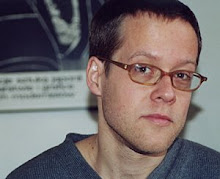
from Laynie Brown's fantastic reading at Dixon Place, 5.9.06
There is nothing wasted in this poetry, and it's full of subtle and unpredictable turnings.
"fire is the quickest of animals"
"vampire squid are kept in jewel boxes"
"I examine the list of things that lie between our temperaments"
"ceremonial constitutions of behavior"
There is nothing wasted in this poetry, and it's full of subtle and unpredictable turnings.
"fire is the quickest of animals"
"vampire squid are kept in jewel boxes"
"I examine the list of things that lie between our temperaments"
"ceremonial constitutions of behavior"
5.21.2006
Mogwai, Webster Hall, 5.12.06
We walked in halfway though the first song, so I missed out on the opening moments where the band arrives and finds their stations, which always tells me a lot about a group. All I could determine was that there were a bunch of guys on the stage all dressed exactly like Brandon Downing.
The first thing I noticed about the sound was that the mix was crystal clear and not too loud. It was, hands down, the most conscientious mixing of any rock band in a venue this size I have ever heard. They had no stage presence, or, I should say, they had a classic shoegazer stage presence. They literarily looked at their shoes for the entire show, and barely moved, though they were intent-seeming and did seem to enjoy themselves. Careful, crystalline production of their signature sound is what they were there for. They actually seemed uncomfortable with themselves on stage physically- which worked fine. The audience seemed to reflect some these characteristics - being mostly polite mid-to-late twenties couples totally engrossed in the music.
There were almost no vocals. The vocals that Mogwai did use were arranged like instrumental parts - vocoder-ized and produced with no particular fanfare by the keyboard player. I was surprised to find that my absorption in the show was delayed my the lack of vocal drama. That expectation of a rock show must run a little deeper than I realized, since 70% of my CD collection is instrumental music in the form of jazz... People do need a character to identify with. Mogwai works a little differently, though -- they produce an environment that the listener is gradually absorbed into, and hopefully, swept up in. At the beginning of songs, audience members were clapping and cheering in recognition after a single bar of a picked guitar pattern was played. This made me think that listeners were spending a lot of time with the albums, perhaps to the point of self-medicating with them.
Much of Mogwai's music is based on petal-point guitar picking patterns contrasted against big, layered, power chord riffs, giving a modal feel but with the excitement of heavy rock music --all with a broad underlying spectrum of texture that ranges from single-note tremolo picking to lush organ to jagged guitar noise. The subdued picking patterns are build into huge, gothic power chord landscapes, creating an undeniable feeling of expanding scale, riff-switching between earthy and celestial effects.
5.15.2006
5.12.2006
5.08.2006
Shanna Compton, Down Spooky, Winnow Press, 2005
Portraits and landscapes with verbal playfulness chops out the wazoo. Vocab harmonics -- "traffic light" / "light subjectivity," intertwined scenes and wordplay are all executed with a crucial balance of relaxation and density of detail that rewards repeated readings. Complex and casual, the poems in Down Spooky use appealingly jumbled details on the surface, an engaging rhythm and a narrative subtext moving underneath: fun, alert, charming, and animated with a buoyant, light touch.
Pet peeve: the introduction uses my least favorite intro strategy: the introducer is more interested in the introduction as an occasion for his own expression than in saying something to the point about the poems.
Compton uses phrases that balance alluring and puzzling qualities. - "hookymaking convincability" along side carefully crafted dreamy epistolary textures: "My dear and loving head wound"
"my sister and I once spent the day / walking around in Brooklyn / We watched a Capybara do / nothing, for like an hour."
What feel like word replacement effects work right alongside a Creeley sing-song modality and place / mood suspended chords under charged lines of sharp giddiness and beauty. And the wordplay permeates the settings and portraits, it doesn't just sit on the surface of the poems.
High School reminiscences.
In "Last Paragraph" the address of the poem and the address between the characters in it is intentionally blurred. Here, Compton uses a scene -- an account of a moment in a relationship where the vocabulary in the poem seems to be almost taking over the story, and this makes for a layered harmonic effect. I think this quality of her poetry is related to the way certain choice sentences / lines spoken in the midst of a personal conflict between lovers or friends can stick with you for years after the fight is long over - as much or more than a line of poetry can. The words take on a life of their own, and this might have as much to do with language and poetry as it does with memory and emotion. Compton's poetry is especially keyed into these interlocked processes.
"Map of the City" uses appropriation of and/or is written the style of a state tourist pamphlet, except it could apply to any state, and seems to have more to do with how a city is remembered or thought about than how it is sold. So this is a kind of satire where the purpose isn't (just) to make fun of something but to use the satirical mechanism, the taking up of a voicing, to activate another artistic effect.
"all are washed over by the paradox of open space"
Compton will go from a gentle, almost pastoral poem involving birds to "The day of prophesy has come and gone. / It seems our father never did possess / any ecclesiastical spacecraft."
Blurred barhopping accounts.
Some lines are worthy of Rogers and Hammerstein, with an extra comic twist: Let's skip / the argument about who's haircut's / worst in the senior picture/ At least you weren't wearing a boa."
Some of the poems are left underdeveloped. They work better when she's combining more elements. She has a contained swagger and in places I want even more swagger -- with less decorum.
Compton always adds a little wry distance just where it will do the most good -- in the few places where a poem is listing towards sentimentality or cliché. Or she'll deploy a cliché on purpose, but with a intervention: "The river pretends / to be caressed by a breeze."
As in James Schuyler, some poems work well as vivid, pleasurable portraits or scenes but also operate on another level, but with so little fuss that you might not even notice it on first reading: The "the slow desiccation of an espresso drop / on the countertop, it's pep all lost" works as a scene and a joke, but Compton is also thinking with the images -- in this poems (and others) there is a kind of meditation on the passage of time -- the drying of a drop of coffee on a table's surface.
In Down Spooky, literary references are delivered in the style of Ella Fitzgerald: "Marianne would discus the fauna, / but I'm not gonna. It's enough / to sip this drink and await the flutter."
Synesthetic, comic impressionism.
4.28.2006
4.26.2006
4.22.2006
4.12.2006
Wolf Parade, Webster Hall, 4/10/06
Next time I go to venue like Webster Hall I'm going to have try showing early and getting a seat in the balcony. We snagged the last passable standing real estate a half hour before the headliner's hit time, so we missed Holy Fuck entirely and caught the last few songs of French Kicks, who were relatively unobjectionable. The show was sold out long ago, so of course we're immobilized in a dense underbrush of nervous twenty-one-year-old white kids. Normally this would be endurable when the music is good, except for cases where someone in front of you smells like a poorly maintained kennel, as was unfortunately the case on Monday.
The band came out maybe five minutes behind schedule and Spencer Krug, singer and keyboard player, immediately apologized for being late. This pattern continued for the entire set -- they barely said anything between songs, but when they did, it was to apologize for something, that they "suck at this" for instance. No one in the group made eye contact with the audience for the entire show, favoring a space on the floor just in front of them, and the guitar player and bass player played with their backs to the audience for the first two songs. The general stage presence was shyness mixed with mild self-effacement. The vibe of the band actually got more introverted as the evening went on, but with an increasing intensity, as though there was only one direction for the drama of the performance to go, which was toward the inside of the band's overall sound, not outward toward the audience from the individual members. It worked.
Wolf Parade's strategy is to layer up thick, balanced textures and use a lot of lead synth melody. Hadji Bakara played a reverb-&-delay-drenched theremin that expanded the timboral landscape of the songs with some Mariana trench-like moments, providing a needed element of gentle menace without departing from the catchiness or late post-adolescent dramatic intensity. In the beginning of the set it felt like they were holding back a little, but it got better as it went along, with some very broad and quite pleasurable peak-outs toward to end and in the encore. There's so little energetic or tempo variation or density contrast in the song structures that it almost doesn’t read as pop music, it's almost a drone music, though the keyboard melodies are pushing Cars-level catchiness in many tunes. Krug and Dan Boeckner sing equally well, and both use a similar kind of stylized warbly cracking intensity that seems like someone politely controlling emotions that are bigger than they are. The pop music of not being able to help how you feel.
4.06.2006
4.02.2006
I noticed that in David Orr's New York Times Book Review cover story on Elizabeth Bishop he complains that more people know the lyrics to Total Eclipse of the Heart than know Elizabeth Bishop's poetry. It seemed to me that it might be more interesting to combine these two writers rather than setting them up in a false binary, so below is a line by line combination of Bishop's Florida with Jim Steinman's Total Eclipse of the Heart.
The Total Eclipse of Florida
Turnaround, Every now and then I get
out among the mangrove islands,
a little bit helpless and I'm lying like a child in your arms.
They stand on the sand-bars drying their damp gold wings.
Turnaround, Every now and then I get to an un-lit evening,
a little bit angry and I know I've got to get out and cry.
Enormous turtles, helpless and mild,
turnaround. Every now and then I
die and leave their barnacled shells on the beaches,
a little bit terrified but then I see the look in your eyes
and their large white skulls with round eye-sockets.
Turnaround bright eyes, Every now and
I'm twice the size of a man then I fall apart.
And the palm trees clatter in the stiff breeze
Turnaround bright eyes, Every now and then I
like the bills of the pelicans and the tropical rain comes down.
then I fall apart,
to freshen the tide-looped strings of fading shells.
And I need you now tonight:
Job's Tear, the Chinese Alphabet, the scarce Junonia,
and I need you more than ever,
parti-colored pectins and Ladies' Ears,
and if you'll only hold me tight
arranged as on a gray rag of rotted calico,
we'll be holding on forever.
the buried Indian Princess's skirt
will only be making it right
with these the monotonous, endless, sagging coast-line
cause we'll never be wrong together.
Delicately ornamented,
we can take it to the end of the line,
Thirty or more buzzards are drifting down, down, down.
Your love is like a shadow on me all of the time,
over something they have spotted in the swamp.
I don't know what to do and I'm always in the dark
in circles like stirred-up flakes of sediment.
We're living in a powder keg and giving off sparks,
sinking through water.
I really need you tonight,
smoke from woods-fires filters fine blue solvents.
Forever's gonna start tonight,
on stumps and dead trees the charring is like black velvet.
Forever's gonna start tonight--
the mosquitoes,
once upon a time I was falling in love,
hunting to the tune of their ferocious obbligatos,
But now I'm only falling apart.
After dark, the fireflies map the heavens in the marsh.
There's nothing I can do
until the moon rises.
A total eclipse of the heart.
Cold white, not bright, the moonlight is coarse-meshed,
Once upon a time there was light in my life
and the careless, corrupt state is all black specks.
Now there's only love in the dark,
too far apart, and ugly whites; the poorest.
Nothing I can say post-card of itself.
A total eclipse of the heart
After dark, the pools seem to have slipped away.
--Jim Steinman/ Elizabeth Bishop
Watched the DVD of John Water's Pink Flamingos, last seen at a midnight showing sometime in the mid-eighties in NJ. Much of the intensely particular feel of the film comes from the spontaneous nature of the shooting, and the way the monetary constraints were handled in the production, and may explain why his later movies retain the charm but lack the poetic of this period. The use of a single, appropriated camera and rescued film stock, combined with the odd and hilarious mixtures of hand-make/thrift shop set design and wardrobe combine to form some very strange color schemes and textures. There's a particular feel for wall paper in the movie. The repeated long single-shot scenes come from the constraint of only having one (stolen) camera. The effect created successfully combines several odd elements-- especially a feeling that everything in the movie, regardless of setting, is somehow actually taking place on a high school multipurpose room stage. This coexists with a Night of the Living Dead horror/documentary realism effect, and this binary defines the film's poetic. The acting also style fuses odd but effective elements -- amateurish but absorbing, intimate but artificial, gross but somehow touching.
The famous scene of the burning trailer where the camera perversely lingers over the flames is explained away by Waters in the commentary track as "bad editing," but there's something that he's missing about his own film here. There is a dynamic of inclusively which depends upon the overall equation of rough on-the fly production, perversity, humor and pathos, and this inclusiveness allows this fire scene, which would otherwise bring everything to a screeching, incongruous halt, to actually work in the overall rhythm of the film. The flames, clearly out of control of the under-prepared filmmakers, take on a beautiful hyper reality that actually harmonizes with the angry, pre-punk rebelliously anti-social creative energy that the director and cast channel into in the project. It also harmonizes with the poetics of fixation that are so clearly a part of Waters' approach.
The famous scene of the burning trailer where the camera perversely lingers over the flames is explained away by Waters in the commentary track as "bad editing," but there's something that he's missing about his own film here. There is a dynamic of inclusively which depends upon the overall equation of rough on-the fly production, perversity, humor and pathos, and this inclusiveness allows this fire scene, which would otherwise bring everything to a screeching, incongruous halt, to actually work in the overall rhythm of the film. The flames, clearly out of control of the under-prepared filmmakers, take on a beautiful hyper reality that actually harmonizes with the angry, pre-punk rebelliously anti-social creative energy that the director and cast channel into in the project. It also harmonizes with the poetics of fixation that are so clearly a part of Waters' approach.
3.24.2006
3.18.2006
2.24.2006
More adventures in the Rhodes-o-sphere.
Pyramid: Lee Konitz, Paul Bley, Bill Conners, 1977, Improvising Artists
Track 2: Out There (Lee Konitz)
Bley plays a Rhodes on the first half of this track, mostly doing a one-note tremolo sustain. The thing about a tremolo sustain on a Rhodes is that the instrument fights it- partly because of the action, which is stiffer than a piano, and partly because the attack shape of the tone is long, so a quick tremolo roll cuts off before the full attack is done. But the rhythmic effect created don't sound like a _hampered momentum_ as you might expect -- it sounds like any situation where you have to maintain persistence in a resistant environment or in the face of some natural disadvantage. It sounds like energy which is about to exert itself. Coming into the solo, Bley slows the tremolo down to open up the full tone a little, and does a very brief interlude where he foregrounds the lush bass tones of the instrument.
2.05.2006
Saw Kevin and Dodie at their packed show at White Columns gallery -- art related to Mirage magazine. Fran Herndon painting, signed poster for a Kenneth Anger film (which I coveted) , a photo of Tim Davis w/ hair, an Emilie Clark piece, and several other things related to the autograph theme of the Mirage covers. Regretted not being able to make their reading the next day.
Sat afternoon I was able to make it to Gary Sullivan's reading at the BPC, which was the best reading I've heard him give -- absolutely hilarious and totally committed to his performance. Ran into Kit Robinson and Marianne Shaneen, among many others.
Sat afternoon I was able to make it to Gary Sullivan's reading at the BPC, which was the best reading I've heard him give -- absolutely hilarious and totally committed to his performance. Ran into Kit Robinson and Marianne Shaneen, among many others.
2.03.2006
2.01.2006
The Miseducation of Lauryn Hill was too ubiquitous for me to listen to much at the time, but now that I go back to it I have to say the arrangements really are fantastic. Particularly interesting to me are the harp parts courtesy of Elisabeth Valletti. Also: the perfectly placed timpani on Ex Factor. Harp and timpani are both instruments that sound particularly good represented via speakers -- they blend well with paper and magnets.
As much as I dislike between song skits and flat vocal quavering, this is a great album. You can hear a lot of people working together here, and that they're contributing and involved creatively, not banging out pro parts. The vision is really focused by Hill as an arranger.
As much as I dislike between song skits and flat vocal quavering, this is a great album. You can hear a lot of people working together here, and that they're contributing and involved creatively, not banging out pro parts. The vision is really focused by Hill as an arranger.
Subscribe to:
Posts (Atom)