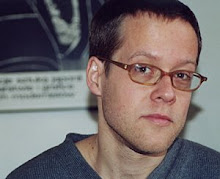
Wolf Parade, Webster Hall, 4/10/06
Next time I go to venue like Webster Hall I'm going to have try showing early and getting a seat in the balcony. We snagged the last passable standing real estate a half hour before the headliner's hit time, so we missed Holy Fuck entirely and caught the last few songs of French Kicks, who were relatively unobjectionable. The show was sold out long ago, so of course we're immobilized in a dense underbrush of nervous twenty-one-year-old white kids. Normally this would be endurable when the music is good, except for cases where someone in front of you smells like a poorly maintained kennel, as was unfortunately the case on Monday.
The band came out maybe five minutes behind schedule and Spencer Krug, singer and keyboard player, immediately apologized for being late. This pattern continued for the entire set -- they barely said anything between songs, but when they did, it was to apologize for something, that they "suck at this" for instance. No one in the group made eye contact with the audience for the entire show, favoring a space on the floor just in front of them, and the guitar player and bass player played with their backs to the audience for the first two songs. The general stage presence was shyness mixed with mild self-effacement. The vibe of the band actually got more introverted as the evening went on, but with an increasing intensity, as though there was only one direction for the drama of the performance to go, which was toward the inside of the band's overall sound, not outward toward the audience from the individual members. It worked.
Wolf Parade's strategy is to layer up thick, balanced textures and use a lot of lead synth melody. Hadji Bakara played a reverb-&-delay-drenched theremin that expanded the timboral landscape of the songs with some Mariana trench-like moments, providing a needed element of gentle menace without departing from the catchiness or late post-adolescent dramatic intensity. In the beginning of the set it felt like they were holding back a little, but it got better as it went along, with some very broad and quite pleasurable peak-outs toward to end and in the encore. There's so little energetic or tempo variation or density contrast in the song structures that it almost doesn’t read as pop music, it's almost a drone music, though the keyboard melodies are pushing Cars-level catchiness in many tunes. Krug and Dan Boeckner sing equally well, and both use a similar kind of stylized warbly cracking intensity that seems like someone politely controlling emotions that are bigger than they are. The pop music of not being able to help how you feel.
4.12.2006
4.06.2006
4.02.2006
I noticed that in David Orr's New York Times Book Review cover story on Elizabeth Bishop he complains that more people know the lyrics to Total Eclipse of the Heart than know Elizabeth Bishop's poetry. It seemed to me that it might be more interesting to combine these two writers rather than setting them up in a false binary, so below is a line by line combination of Bishop's Florida with Jim Steinman's Total Eclipse of the Heart.
The Total Eclipse of Florida
Turnaround, Every now and then I get
out among the mangrove islands,
a little bit helpless and I'm lying like a child in your arms.
They stand on the sand-bars drying their damp gold wings.
Turnaround, Every now and then I get to an un-lit evening,
a little bit angry and I know I've got to get out and cry.
Enormous turtles, helpless and mild,
turnaround. Every now and then I
die and leave their barnacled shells on the beaches,
a little bit terrified but then I see the look in your eyes
and their large white skulls with round eye-sockets.
Turnaround bright eyes, Every now and
I'm twice the size of a man then I fall apart.
And the palm trees clatter in the stiff breeze
Turnaround bright eyes, Every now and then I
like the bills of the pelicans and the tropical rain comes down.
then I fall apart,
to freshen the tide-looped strings of fading shells.
And I need you now tonight:
Job's Tear, the Chinese Alphabet, the scarce Junonia,
and I need you more than ever,
parti-colored pectins and Ladies' Ears,
and if you'll only hold me tight
arranged as on a gray rag of rotted calico,
we'll be holding on forever.
the buried Indian Princess's skirt
will only be making it right
with these the monotonous, endless, sagging coast-line
cause we'll never be wrong together.
Delicately ornamented,
we can take it to the end of the line,
Thirty or more buzzards are drifting down, down, down.
Your love is like a shadow on me all of the time,
over something they have spotted in the swamp.
I don't know what to do and I'm always in the dark
in circles like stirred-up flakes of sediment.
We're living in a powder keg and giving off sparks,
sinking through water.
I really need you tonight,
smoke from woods-fires filters fine blue solvents.
Forever's gonna start tonight,
on stumps and dead trees the charring is like black velvet.
Forever's gonna start tonight--
the mosquitoes,
once upon a time I was falling in love,
hunting to the tune of their ferocious obbligatos,
But now I'm only falling apart.
After dark, the fireflies map the heavens in the marsh.
There's nothing I can do
until the moon rises.
A total eclipse of the heart.
Cold white, not bright, the moonlight is coarse-meshed,
Once upon a time there was light in my life
and the careless, corrupt state is all black specks.
Now there's only love in the dark,
too far apart, and ugly whites; the poorest.
Nothing I can say post-card of itself.
A total eclipse of the heart
After dark, the pools seem to have slipped away.
--Jim Steinman/ Elizabeth Bishop
Watched the DVD of John Water's Pink Flamingos, last seen at a midnight showing sometime in the mid-eighties in NJ. Much of the intensely particular feel of the film comes from the spontaneous nature of the shooting, and the way the monetary constraints were handled in the production, and may explain why his later movies retain the charm but lack the poetic of this period. The use of a single, appropriated camera and rescued film stock, combined with the odd and hilarious mixtures of hand-make/thrift shop set design and wardrobe combine to form some very strange color schemes and textures. There's a particular feel for wall paper in the movie. The repeated long single-shot scenes come from the constraint of only having one (stolen) camera. The effect created successfully combines several odd elements-- especially a feeling that everything in the movie, regardless of setting, is somehow actually taking place on a high school multipurpose room stage. This coexists with a Night of the Living Dead horror/documentary realism effect, and this binary defines the film's poetic. The acting also style fuses odd but effective elements -- amateurish but absorbing, intimate but artificial, gross but somehow touching.
The famous scene of the burning trailer where the camera perversely lingers over the flames is explained away by Waters in the commentary track as "bad editing," but there's something that he's missing about his own film here. There is a dynamic of inclusively which depends upon the overall equation of rough on-the fly production, perversity, humor and pathos, and this inclusiveness allows this fire scene, which would otherwise bring everything to a screeching, incongruous halt, to actually work in the overall rhythm of the film. The flames, clearly out of control of the under-prepared filmmakers, take on a beautiful hyper reality that actually harmonizes with the angry, pre-punk rebelliously anti-social creative energy that the director and cast channel into in the project. It also harmonizes with the poetics of fixation that are so clearly a part of Waters' approach.
The famous scene of the burning trailer where the camera perversely lingers over the flames is explained away by Waters in the commentary track as "bad editing," but there's something that he's missing about his own film here. There is a dynamic of inclusively which depends upon the overall equation of rough on-the fly production, perversity, humor and pathos, and this inclusiveness allows this fire scene, which would otherwise bring everything to a screeching, incongruous halt, to actually work in the overall rhythm of the film. The flames, clearly out of control of the under-prepared filmmakers, take on a beautiful hyper reality that actually harmonizes with the angry, pre-punk rebelliously anti-social creative energy that the director and cast channel into in the project. It also harmonizes with the poetics of fixation that are so clearly a part of Waters' approach.
3.24.2006
3.18.2006
2.24.2006
More adventures in the Rhodes-o-sphere.
Pyramid: Lee Konitz, Paul Bley, Bill Conners, 1977, Improvising Artists
Track 2: Out There (Lee Konitz)
Bley plays a Rhodes on the first half of this track, mostly doing a one-note tremolo sustain. The thing about a tremolo sustain on a Rhodes is that the instrument fights it- partly because of the action, which is stiffer than a piano, and partly because the attack shape of the tone is long, so a quick tremolo roll cuts off before the full attack is done. But the rhythmic effect created don't sound like a _hampered momentum_ as you might expect -- it sounds like any situation where you have to maintain persistence in a resistant environment or in the face of some natural disadvantage. It sounds like energy which is about to exert itself. Coming into the solo, Bley slows the tremolo down to open up the full tone a little, and does a very brief interlude where he foregrounds the lush bass tones of the instrument.
2.05.2006
Saw Kevin and Dodie at their packed show at White Columns gallery -- art related to Mirage magazine. Fran Herndon painting, signed poster for a Kenneth Anger film (which I coveted) , a photo of Tim Davis w/ hair, an Emilie Clark piece, and several other things related to the autograph theme of the Mirage covers. Regretted not being able to make their reading the next day.
Sat afternoon I was able to make it to Gary Sullivan's reading at the BPC, which was the best reading I've heard him give -- absolutely hilarious and totally committed to his performance. Ran into Kit Robinson and Marianne Shaneen, among many others.
Sat afternoon I was able to make it to Gary Sullivan's reading at the BPC, which was the best reading I've heard him give -- absolutely hilarious and totally committed to his performance. Ran into Kit Robinson and Marianne Shaneen, among many others.
2.03.2006
2.01.2006
The Miseducation of Lauryn Hill was too ubiquitous for me to listen to much at the time, but now that I go back to it I have to say the arrangements really are fantastic. Particularly interesting to me are the harp parts courtesy of Elisabeth Valletti. Also: the perfectly placed timpani on Ex Factor. Harp and timpani are both instruments that sound particularly good represented via speakers -- they blend well with paper and magnets.
As much as I dislike between song skits and flat vocal quavering, this is a great album. You can hear a lot of people working together here, and that they're contributing and involved creatively, not banging out pro parts. The vision is really focused by Hill as an arranger.
As much as I dislike between song skits and flat vocal quavering, this is a great album. You can hear a lot of people working together here, and that they're contributing and involved creatively, not banging out pro parts. The vision is really focused by Hill as an arranger.
1.31.2006
I'm amazed that there are some people capable of taking my this-one-goes-to-eleven-grade sarcasm in "Chicks Dig War" at face value.
The process of writing the poem started with gathering source material with a set of google search on "chicks dig" and "chicks really dig," and then improvising search and replaced Iraq war stuff into resulting items and then heavily re-editing and re-sequencing it. It's obvious if you read the poem in the context of the book that it's an absurd anti-war poem using an appropriated vocabulary of male insecurity, and pitching a confident logic that doesn't make any sense. It was written to match the media absurdities we were inundated with at the time it was written at the height of the war (and still are), where the thinking and opinions being bandied around on the TV, from the administration, and in the New York Times seemed often to have about as much actual rationality as this poem. I wanted to go with absurdity in approaching political material when we seemed to be in an area of the cultural landscape where rationally suddenly wasn't allowed at all.
The poem is so packed with self-cancellations and reversals and is so flagged as sarcastic that ... but I guess there must be people who are angry and bewildered at the right wing Stephen Colbert too right? so... let em think that!
1.29.2006
Herbie Hancock, Crossings.
West African-sounding drum arrangements with vivid, coherent, stretching Rhodes soloing from Hancock. Like a cross between Bitches Brew and Sun Ra. Julian Priester is on it, and there are moog sections via Patrick Gleason (note his Amazon comments above). It must have freaked out his record company. Twenty minutes songs broken into suites. Rubato and out-of-time passages as well as deep, straight-ahead grooves, though with Billy Hart almost never on the two and four. Nearly Harold Buddish ambient passages. Other sections have a lot of activity but don't sound busy. It would fit into a prog framework except for the jazz chord voicings, and the balance of activity with relaxation. Prog has to be tense. Also, no one on Crossings solos towards anything show-offy. It's ensemble playing, with range and depth.
West African-sounding drum arrangements with vivid, coherent, stretching Rhodes soloing from Hancock. Like a cross between Bitches Brew and Sun Ra. Julian Priester is on it, and there are moog sections via Patrick Gleason (note his Amazon comments above). It must have freaked out his record company. Twenty minutes songs broken into suites. Rubato and out-of-time passages as well as deep, straight-ahead grooves, though with Billy Hart almost never on the two and four. Nearly Harold Buddish ambient passages. Other sections have a lot of activity but don't sound busy. It would fit into a prog framework except for the jazz chord voicings, and the balance of activity with relaxation. Prog has to be tense. Also, no one on Crossings solos towards anything show-offy. It's ensemble playing, with range and depth.
1.25.2006
Some interesting stuff over at Limetree with the Basboll Jennifer Moxley vs. Billy Collins challenge:
Collins has a certain way with words, even though I'm put off by what he's saying, and what it implies. Kind of like Phillip Larkin, who also has a certain skill with words, but who I'm totally horrified by beyond that. Collins approximates the relaxed, immediate tonal effects of Kenneth Koch, but to very different ends. The poem in question at first seems like a relaxed accounting of comfort with and pleasure in one's environment and life. Sort of. Okay, read it again: it's a tense, naked celebration of self-satisfied complacency. Yes, but there's more. Read it again: what it's doing is locating the process of writing (a writer's table and solitude and pen is the setting) as a mechanism for asserting a separation of selfhood and history. It's saying that writing is about using one's creativity to call up a triumphant fantasy of withdrawn total independence from the world. It's saying you don't have to engage with the actual environment you exist in because you can withdraw into a private magic circle where you have no needs and you have no claims from the outside world apart from how you wish to imagine it for your own comfort. So it's actually neurotic power fantasy: a very common poetic one in fact. This poem is the embodiment of a defensive disconnection presenting itself as happiness. The affect of the words doesn't lie. There's no real joy in the feel of the poem, there's tension, because the poem claims to take pleasure but actually clings uneasily to a defensive fantasy. The tone is seemingly Kochian, but it's a long way from Koch, who would never bother with this insisting on being in control of some imagined suit of armor of independence from context. He would use a related tone, but would drawn down details and information from the environment, the pleasure of life, and mix them with playful rearrangements responses that would actually engage the human and social vibe of that environment and of it's actual, dependant pleasures and comforts.
The Moxley poem is similar in several ways: the setting, the details and some of the themes. Her chops are much more advanced, and are put into the service of different things. Comparing Moxley to Collins is like comparing June Tyson to Bing Crosby. The Moxley poem is about rejecting some social pressure to over-plan life in the name of comfort and security. So, like Collins, it involves a rejection of claims being made upon one, but it feels like specific claims being responded to in a specific context. It's engaged. Read it again-- it's saying: I don't want to arrange my life (and my mind) so that everything is totally safely planned out ahead of time according to some standard social material script. It's reacting to the suffocation of material comfort and safety and the vision of time and change that goes along with that. Like the Collins poem it deals with a kind of psychological need for independence, bit it handles it much differently.
1.24.2006
Abhishek Bachchan acquits himself pretty well on the thumping 50-Cent-via-Bollywood "Right Here Right Now" track from Bluff Master.
1.21.2006
I picked up the ideal volume of Taylor Mead poetry: a signed paperback of On Amphetamine and in Europe, Excerpts from the Anonymous Diary of a New York Youth (Boss Books, 1968), the edge of which is well chewed through by a dog. You can see the individual tooth indentations. I think a forensics person could identify the dog with this book. It's hilarious.
Mead manages to be equal parts ingenious and feeble. Like the perfect mixture of Jack Kimball and Hal Sirowitz.
"Pardon me while I disband our friendship."
Print this over a jpeg of a strapping Macy's model and you got Jack Kimball, right?
Hal Sirowitz has a more studied stupidity and less natural persona inspiration than Mead, but here's the's Sirowitz mode:
"The reason I'm an idiot is because I'm so intelligent I've transvalued intelligence."
Some raw specks of proto-flarf:
"The sun is so orange it's pathetic"
and
"rabbits are eating my underwear"
Some is high resolution glammed abhorrence:
"wine should not be sold to people over 40"
1.17.2006
Bill Withers, Use Me
A perfect arrangement of simple materials. The song is a single clavinet vamp with no B section or chorus, just one brief drum break, of a tastiness not to be believed. It has a stripped down funk instrumentation: clavinet, bass, drums, guitar, vocals. The relationship of syllable placement to the Modeliste-esque drum groove is incredible - two fields of mutually enhancing pulsations. It's the spaces allowed in these overlapping rhythms that gives this tune it's amazing resolution of relaxation and forward momentum.
A perfect arrangement of simple materials. The song is a single clavinet vamp with no B section or chorus, just one brief drum break, of a tastiness not to be believed. It has a stripped down funk instrumentation: clavinet, bass, drums, guitar, vocals. The relationship of syllable placement to the Modeliste-esque drum groove is incredible - two fields of mutually enhancing pulsations. It's the spaces allowed in these overlapping rhythms that gives this tune it's amazing resolution of relaxation and forward momentum.
iPod notes
Husker Du, Warehouse Songs.
Husker Du was one of several blessings that got me though New Jersey suburban public high school in the mid 80s. I can still remember a major shift in my musical brain when I brought home the 45 of Husker's cover of The Byrds' Eight Miles High, totally floored by the passion of the singing, and the noisy, expansive guitar sound. It felt like whole set of confined emotions being released all at once. It would have sounded like pointless, angry noise to most people around me, and I greeted it with the relief and joy of suddenly and unexpectedly being understood.
What I couldn't have known at the time, and what I see now looking back on the musical archeology, was that I was receiving an odd, multilayered transmission of American modal sound that went from John Coltrane to The Byrds to Husker Du.
As a teenager, I avidly collected any Husker Du I could get my hands, which was most of it, I think, because I was lucky enough to live within driving distance of The Princeton Record Exchange - a crucial source of music in that area.
I know I'm not alone among people my age in feeling that Zen Arcade is the Husker Du masterpiece. I still think that. By the time Warehouse Songs came out - '87, on the major Warner Bros., I recall thinking they had sold out or something, and consequently didn't pay much attention to Warehouse Songs. What is it about the teen age mind - not fully wired yet they say?
Warehouse Songs is actually great pop/punk way ahead of its time. I can now appreciate the more shimmery production and get into the pop element. Simple, short earnest songs that just define their own parameters of reality and expression and communication, often in an unabashedly dramatic and sometimes almost theatrical way. Yet I still feel I am in the presence of real people, which is often the thing that is missing in very dramatic music.
One natural reaction is to say the Grant Hart songs aren't as good as the Bob Mould Songs. But there's something that happens in toggling between the two that expands the information grid you're working with over the course of the album. The more muted patterns of the Hart songs and the more brilliant patterns of the Mould material form a moiré pattern.
1.16.2006
Jordan Davis and Chris Edgar, Poetry Project, 1/1/06
Chris Edgar
"tiny halos of not"
"I asked the Verizon guy to use as many sixes as he could"
Jordan Davis
"Dad, please stop rhyming"
"Alligator in mirror might be nicer than it appears"
Jordan read a hilarious series of poems whose titles were taken from the stat-counter info about what Google searches led readers to his poetry blog, such as "Turtles Generate Poetry."
1.15.2006
Twenty Ruptured Paragraphs, Noah Eli Gordon, subpress Self-publish or Perish
Excellent, meditative prose-poem chapbook in the subpress self-bootlegging tradition. Actually far from ruptured -- rather, carefully assembled (new?) sentences maintaining continuity of theme without being restricted to continuity of context: puns, riffs, sudden segues, questions, details, thoughts. There is a combination of elements and attitude which feels like a fusion of Stephen Rodefer, John Clarke, and Ron Silliman.
The feedback tonic note of checking in with writing processes as you're using them is sustained though every piece, but doesn't feel belabored or obligatory, and each paragraph has at least one killer sentence. Gordon isn't afraid of allowing the sentences to quickly shift from graceful to awkward when it advances the building propositional overtones.
1.10.2006
Picked up Herbie Hancock, Secrets last weekend. Wonderful advanced art/party music. The kind of thing that pisses off jazz purists (or rock/funk purists for that matter), which makes me love it all the more. I tend to admire anything that angers zealots. The opening track, "Doin' It," has an almost minimalist (in the sense of Riley or Reich) pattern interweaving. What could you call this now to keep the fusion scare quote thing at bay... post-soul-music?
1.02.2006
The Poetry Project New Year's Day Marathon reading is about the gradual accumulation of many voices over a long period of time. This year it made me think of The Coltrane Church in San Francisco, which I sometimes went to when I was living in SF in the early nineties. It had four or five-hour ceremonies, comprised mostly of music (including all of a Love Supreme) and a sermon that was all about politics. I'm a card-carrying atheist, but I liked the vibe at the Coltrane Church because level of playing was so high -- often much better than what was in the jazz clubs. The other thing I liked about it was the creative, communal vibe -- half the audience was carrying instruments, and would come up to take solos. This process could go on for a long time, and the quality of playing could range from great to abysmal, but it didn't matter, because the social vibe included a suspension of critical judgment, or, at any rate, suspension of the type of critical judgment that most resembles making impatient and repeated special demands on a waiter while eating out. Some players would be good and some bad, but anyone who wanted to be included would be, and the overall social/creative collectivity was what it was about. It was a refreshing change of context from the social frames of the jazz and poetry scenes, both of which were (and are, in NYC as in SF) ostensibly communal but as deeply competitive as any professional sports in reality. Not that I'm totally against that, cooperative and competitive modes both have their place. But I never left the Coltrane Church feeling - wow, that person was awful (no matter how weak some of the individual playing might have been). It was always like -- a beautiful mass of variegated social/musical information -- which is what the New Year's marathon is like.
In poetry there's almost no difference between the audience and the artist. At the New Year's reading you get up from the audience and read (to a room that is mostly other poets) and then sit back down while another poet gets up from the audience and reads and sits back down etc. At a rock show, the artist is pointedly superior to you and separated from you, and that's how you want it -- you're using them as an avatar, and fantasying about having their power. At the marathon reading the one actual rock star, Patti Smith, also gets up from the audience and then sits down with everybody else (she was actually sitting next to me this year). Of course, all the 15-20 year olds pour out as soon as she's done. (I'm no doe-eyed Patti Smith fan, but her performance this year was quite good -- solo w/ guitar playing a single Indian-inflected D-chord and really belting it out.)
So there's stuff across the spectrum, terrible, great and in-between, and it all accumulates in a way that inevitably makes it about the collective experience. The downside of this is a certain exhaustion, as it was at the Coltrane Church, but the unique context makes it worth it.
It's interesting to see how people handle the situation of being a blip in such a larger event (which is so much what people are as individual biological entities anyway). Some read one or two short poems and in a modest way (surely the most difficult thing to pull off). Some read one short strong piece. Some go three times too long with weak, unrehearsed material. Some blare theater chops. Some mix poetry and music. Some trot out well worn clichés. Some open a detailed window. Some make people laugh. Some do hilarious poetic performance interventions. Some share intimate details. Some evade. Some annoy. Some hint. Some bewilder. Some turn the camp up to eleven. Some declaim. Some list. Some drone. Some mumble. Some chronicle. Some fantasize. Some object. Some charm. Some surprise.
12.29.2005
Ever wonder what it's like to be stranded on a Pacific island? You don't need to be shipwrecked, just have the US government repossess the one plane that goes there.
12.28.2005
Stuff that came out this year, currently residing on silver iPod mini:
Boards Of Canada, The Campfire Headphase
Bonnie "Prince" Billy & Matt Sweeney, Superwolf
Broken Social Scene, Broken Social Scene
Clap Your Hands!, Clap Your Hands Say Yeah!
The Decemberists, Picaresque
Explosions in the Sky, How Strange, Innocence
LCD Soundsystem, LCD Soundsystem
M.I.A.,Arular
Mogwai, Government Commissions: BBC Sessions, 1996-2003
New Pornographers, Twin Cinema
Sigur Rós,Takk
Sufjan Stevens, Illinois
Various artists, Run The Road
Vashti Bunyan, Lookaftering
Wolf Parade, Apologies to the Queen Mar
12.27.2005
Elizabeth Murray, Moma
Katie and I braved an absurdly overcrowded magic-tree-worshiping Rockefeller Center midtown crowd to check out the Elizabeth Murray show at Moma. The show covered several distinct periods. Some notes:
-Casual, doodle-like use of line as a fundamental design element. These kind of lines have as much to do how the tendons, muscles and bones of the arm and hand want to work as they have to do with the visual effects painters seek to create with this technology. Murray uses the kind of lines and interacting shapes you might fill in semi-consciously on a notepad as you talk on the phone, but she brings this to a epic level.
-Insistence on traditional oil on canvas, but custom molding the canvases into puzzle pieces, often in layers, giving the ground of the paintings a unique sense of freedom -- elements related one way that could just as easily be re-arranged and done another way. It gives her partially hybridized approach - painting pushing into sculpture -- the looseness, quickness, levity and freedom of a doodle or piece of off-the-cuff comic art.
-An interestingly complicated take on coloration. The early stuff -- earthy and subdued, the middle stuff -- bold and raucous clashes, the late stuff -- pull out all the stops visionary integration. Not sure you can call it visionary, though, since this work is sane and is possessed of so much levity. It's an entire class of it's own: cute/visionary?
The work in the final room from 2000-2005 was the most interesting for me. On a large scale yet totally approachable, integrating much of what had come before it. Integration in subject matter -- internal organs, pets, tables, rooms, keyholes -- living quarters inside and out. In patterning -- where the elements work together in a loose but highly coherent kind of co-operation without any part being forced into servitude to a grand scheme. All with a wild coloration that made me think of Huichol visionary yarn painting.
12.26.2005
There something about the moment when the Northeast Corridor train emerges from the perpetual darkness of the Penn Station tunnels into the space and light of New Jersey: a sudden expanse of frozen marsh grass, dilapidated power lines and rusting storage containers. The expansive openness and stasis contrast sharply with the constricted views and hyperactivity of the City. You are in another world. It's a moment I never grow accustomed to.
12.15.2005
12.11.2005
12.10.2005
Hybrid Poetry Class #2
Walter Abish, 99:The New Meaning
"Wasn't his body after all, exploiting the capital formation of his thoughts, thriving on surplus value of his mind, and gorging itself on his will?"
Kamau Brathwaite, The Zea Mexican Diary
"And it was here I couldn't help her . . . for the lungs, I was in touch w/ Betelgeuse . . . beating there in the heart of the cold fury of Orion . . . whenever she coughed or seemed in danger, I wd bring that throbbing nebula into the very centre of my head my heart & hold off . . . it seemed . . . whatever was going on wrong..."
Emily Dickinson, The "Master" Letters from Selected Letters
"You send water over the dam in my brown eyes"
12.06.2005
This piece on Petroleum Hat just out in the Dec Publisher's Weekly (click the Google link and scroll down). Check out pieces on Shanna Compton, David Larson and Linh Dinh.
Petroleum Hat
Drew Gardner. Roof (SPD, dist.), $12.95 paper (96p) ISBN 1-931824-17-7
The most salient form of "Google poetry"—or the collaging and strategic search-and-replacing of text from Web searches—has come to be called "Flarf" by an Internet collective that produces a great deal of it. None of the Flarf poets—including K. Silem Mohammad (Deer Head Nation), Gary Sullivan (How to Proceed in the Arts; he wrote the first Flarf poem, and coined the term) and Katie Degentesh (The Anger Scale, forthcoming)—is exclusively such, as is true for Gardner, also a Flarf listmember. Gardner's debut, Sugar Pill (2003), used hemistichic verse to slow down and process, beautifully, the money-and-information assault of contemporary culture and to develop a countering eco-animism on a par with that of Juliana Spahr. This book, clearly written (or Googled up) in reaction to the current Iraq war and the political climate surrounding it, is a lot more acidly ironic (or, in group parlance, "Flarfy") in an "extreme times, extreme measures" sort of way. Dropping the most absurd first-person declarations (some sweet: "I am reduced to being a fluffy lifeboat again") into nearly 50 lyrics, Gardner conjures the kind of complicated, childish political ignorance and faulty, malevolent citizenship that George Carlin can only joke about. It is this book's particular genius to make tightly grafted stacks of assertions like "A woman's hormone-driven 'logic'/ will equate power with war" (from "Chicks Dig War") start to look like a cable news crawl. (Dec.)
12.01.2005
I know not having words is the major stumbling block for many pop/rock listeners trying to approach jazz music. I'm sometimes trying to get away from words in music, because language can have such power to ruin music. When listening to a band that is new to me I sometimes try to avoid understanding the words for as long as possible for this reason.
Listening today to Quasi, Sea Shanty. When I hit "Drifting on the Murky Sargasso of the Everyday," enunciated clearly, I'm like, oh well, I can't go back and suffer though that line again, despite the fact that the music on the track is good.
Listening today to Quasi, Sea Shanty. When I hit "Drifting on the Murky Sargasso of the Everyday," enunciated clearly, I'm like, oh well, I can't go back and suffer though that line again, despite the fact that the music on the track is good.
There's something about the intense acidic beauty of the lead guitar tone in Elliot Smith's Strung Out Again -- it sounds like it is about to come totally unglued but remains intact and strong -- that made me go back and listen to the song three times on the iPod this morning. The feeling of -- shouldn't I be coming a little unglued under some dire but routine set of circumstances -- and yet I'm not? The tone is similar in spirit to the sound in Eddie Hazel's Maggot Brain guitar solo, but ends up in a different place. Hazel allows the substance of his tone to pull completely apart at moments, embracing a dissolving force of experience by channeling it into a kind of escape route.
11.30.2005
11.28.2005
11.20.2005
Friday
from Packet One -- 1st Hybrid Poetry Class, Poetry Project.
Bernadette Mayer from Midwinter Day.
"The Three Little Pigs ... Two of them got eaten by the wolf because they built their houses out of flimsy materials. The third pig who has a brick house which he got by posing as a cripple, winds up boiling the wolf alive and eating him. Admiral Byrd was the first person to spend the winter alone at the South Pole. For a while he did well and wrote a lot of speculations on the nature of the universe, then the stove in his hut began to poison him with fumes."
Rumi, A. J Arberry Trans.
"And even if you turn your back to the water, the water runs hurrying before you. How shall the shadow save its soul from the sun, seeing that its soul is in the hand of the sun? If the shadow stretches forth it's neck, the sun's face that instant is shrouded. Brave Sun, in which this sun in heaven quivers with fear like quicksilver!"
Charles Reznikoff, Testimony
The man at the wheel turned. / with his flashlight: / everybody was turning and pushing against each other; / those near the window / were trying to break them, / in spite of the wire mesh."
New York Times Nightly Television Schedule listings:
"Fire In the Sky (1993) Arizona lumberjack abducted by aliens. Polite to the point of boredom."
"Convoy (1978) Truckers in trouble. Churning but vapid."
Thursday
Sally Silvers: Puppy Skills, PS 122.
25th Anniversary string of pieces including a remixed series of solos choreographed for group dancers. The first piece had a playful vibe, with three of the more seasoned dancers engaged in humorous activities with wearable sculpture and window door/shadow prop. Family dynamics? Sisters? Friends? Maturity? This was followed by the most grueling piece (in a good way) involving the youngest dancers - complex athletic group movement like a Benetton commercial that has been transformed into a extended gender role nightmare from which you cannot escape. A nightmare of youth?
The dancers were all-female, and the complex element in Silver's work of repurposing gender stereotype material was interestingly splayed across the evening in different ways. Every piece had different manifestations of this mixing with her other major dynamic: a drama of characters interacting, stepping in and out of the stage of power, with the relationships changing, and power dynamics between individuals and groups of players constantly shifting positions. The virtuosity of the choreography and dancers somehow ups the ante on the feeling of conflicts in these social themes, which is opposite of what I would normally expect.
Excellent sound collage by Bruce Andrews with Michael Schumacher -- clear, decisive texture switching maintaining intensity without distracting attention away from the dance. I was struck by the similarity in thematics between Silvers' dance and Bruce Andrews' poetry, that they both deal unreservedly with negative social emotions/perception/dynamics and that in both cases these things are transformed into energized dramas.
11.15.2005
11.13.2005
Last night I heard Peter Cully read a long, far-ranging, swinging mid-tempo poem-sequence in Lee Ann Brown and Tony Torn's living room. Peter delivered the poem from a throne-like wooden chair, surrounded on all sides by cake-eating, wine drinking poetic revelers. His vocal intonations mixed nicely with sound of the airplanes coming in through the window. The poem included a gentle rebuke directed toward Albert Ayler: "It is about me."
11.11.2005
11.09.2005
11.04.2005
If there is a lump in the throat feeling gotten from this poem, it is the same kind of feeling gotten from a phone company TV commercial. Other people might value that feeling, but I don't -- it's just business exploiting easy emotional triggering. Can you say certain phone company commercials are well crafted? Sure, you could say the well crafted phone company commercial is successful when it gives you that lump in the throat feeling AND leads you to pay money for the service. Is that un-impeachable? If you're a formalist or have formalist tendencies, I suppose you have to give props to any piece of art that reproduces an agreed-upon template. In this country, tacky, lazy, dishonest workshop treacle is a dominant template. So is smooth jazz. This poem is at a level of like, Special EFX, that is, at or slightly below Kenny G.
11.03.2005
Kasey does an extreme sports version of the standard debate team trick of exaggerating and warping what someone has said in order to score points in opposition to a stance not actually being made. It's not that he's intentionally being dishonest, it's that he wants to get his argument over so badly that he's not responding to what I'm actually saying. He's projecting onto to my statements the position he wants to debate against. For instance he says:
"Drew seems to mean something other by this than simply that he does not appreciate the poem: he implies a quantifiable mechanical deficit on the poet's part (in another comment, he uses the word "ineptitude"). That is, he implies that Oliver literally doesn't have basis syntactic competence, that her metaphors are literally incoherent. Maybe he doesn't really mean this, but if that is the case, this is a perfect example of the way in which dissatisfaction with a poem's general raison d'etre can slide into a hazy use of craft-based terminology."
Clearly he knows he's on shaky ground here. In fact, I went to some lengths to make it clear that I was providing a subjective response to the poem. "So what am I feeling when I read this?" may have been a clue to this. "I see it as a kind of" usually indicates that the speaker is framing their position as a subjective opinion, not the statement of a provable, objective fact. Ditto "The poem seems like total BS to me." Later he backs off the obviously unworkable direct proposition that I'm positing my perceptions and opinions as objective facts, and he substitutes the weaker and vaguer point that some of my vocabulary was enough to imply this. Then we get this:
"First, he invokes the specter of bad craft by denouncing Oliver's supposedly awkward syntax and inert metaphors. Then he says that these defects are not actually indices of Oliver's craft ineptitude at all, but rather that her "attitude toward reality" and toward her own "role" as poet have somehow "resulted" in bad craft. But then isn't her craft the problem on one level after all?"
These solipsistic rhetorical switchbacks don't really address my point so it's hard to comment on them.
"My suspicion here is not that Drew has failed to give coherent expression to his idea, but--more radically--that there is no idea there to give expression to. When we dislike what we believe a poet or poem stands for, too often we convince ourselves that on that basis alone we may assert that the poet's "craft" is lacking."
There's no idea here for Kasey because, at this point, he's finally wriggled free from what I was saying and is peaking on the trip he had set out for from the beginning: this bit of preaching.
10.30.2005
Ange Mlinko and Richard Hell,
St. Mark's Poetry Project, 10.26.05
Before the reading, I was struck by the beautiful crepuscular light of Soho -- the gigantic, uncanny face of Marvin Gaye hovering above Houston St. on a billboard.
Ange Mlinko
The strongest reading I've heard Ange give -- "transformation vs. encryption" -- family and memory -- Duchamp's Etant Donnes in the Philly art museum -- reacting with anger to the piece -- that the figure looked to her like a crime victim -- trying to remember a nightmare -- "an imagination which produces folklore and science alike." -- "Orpheus near store front"
Richard Hell
Hell started with twenty minutes of extemporaneous stories about being one of a couple of "knuckleheaded" punk kids hanging around the periphery of the 1970s St. Mark's poetry scene -- he followed this up with forty-five minutes of amateurish, sloppy, tedious fiction.
10.27.2005
Dreamt that Jordan Davis and I were playing a game of chess, and in the first series of moves, all of our major pieces were mutually destroyed, leaving only pawns, kings and queens.
10.25.2005
Steve identifies the possibility of a new prose genre based on a the script of I Walked With a Zombie.
10.21.2005
My favorite moment of Juliana Spahr's reading at St. Mark's was a lovely, compelling list piece using all manner of species native to the area of Ohio where she grew up. These things were plugged into set phrases like "I let the (raccoon) into my heart, and "(crabapple), don't add to heartache." This localized, highly diffuse environmental information about Ohio (and really much of the northeast US) included poisons as well, "I let the (chloride) into my heart."
Another set phrase was "I didn't even say goodbye to (pumpkin)," where the implication is that a childhood connection to natural environment is gradually and unconsciously replaced by an adult social and sexual environment. The piece would almost fit into Technicians of the Sacred.
She introduced the poems as "sappy." This work did activate a simple, and, in a way, traditional mechanism of sentiment -- feelings associated with connection to the natural environment, but not at all of sentimentality -- displacing actual feelings with formalized, strategic clichés of feeling based on a projection of audience expectation. The poem was a kind of retrospective coming of age poem and environmental protest piece.
10.20.2005
Jennifer Moxley, Often Capital, Flood Editions, 2005
Two early serial poems.
The First Division of Labour:
Themes of partnership / work / love (and estrangement)
"desire returned as topiary"
The poem proceeds though an assembly of vocabulary and detail from a text we’re not necessarily privy to, transforming it, but without rorschaching the material, without rendering it’s interpretive horizon open-ended.
"The minor, graffiti / in / Atlantis"
Enlightenment Evidence:
Excess creativity in humans was possibly evolved as a result of sexual selection?
"Let sweetness be the creator of moments, building revolution / one kissing at a time."
The poet/speaker of this dramatic monologue associates her love life w/ a famous historical character and imbues this dramatic framework with political grandeur. Not a historical take on writing as straight documentary, but using history as cognitive reverb setting for one’s immediate situation. Something both Olson and Creeley do.
"the paramour trades beauty for silence"
Attachment to historical figures and amorous attachment. The problems of attachment -- Sorting through the significance of attachment through the filter of another text/aura -- sorting/attachment/association.
10.19.2005
10.17.2005
It finally stopped raining after a straight week of downpour. I thought I might never see sunlight again.
The mysterious repaving of the East Village continues with the top layer of many streets ripped up and left that way. The dust from the uprooted asphalt gets kicked up by the recent wind, making Ave. B look like the old west.
The mysterious repaving of the East Village continues with the top layer of many streets ripped up and left that way. The dust from the uprooted asphalt gets kicked up by the recent wind, making Ave. B look like the old west.
10.16.2005
The artist must have wanted this footage to be about the surveillance cameras, but the compelling thing about this fox loose in the National Portrait Gallery in London is that the fox is sleeping overnight in the museum. Looks like he found himself a comfy chair.
10.09.2005
Anselm Berrigan and Marianne Shaneen, Bowery Poetry Club, 10.8.05
Marianne Shaneen
Funny, information-rich poetry fused with a poetics of film.
She started with a sequence focused on, and wildly riffing off of, dolphins. Specifically the history of American... uh, use of Dolphins in covert operations. It was sloppy in a good way, that is it was Charles Mingus sloppy: with a relaxed open gangliness capable of accommodating a large amount of elements, all of which were allowed to act with a certain independence, while maintaining an upbeat overall forward momentum.
"The CIA was concerned about a looming 'Dolphin gap' with the Soviets."
"Wealth is a form of violence."
The second series was organized around themes of oil / petroleum, ranging over the politics of oil production, inescapable plastic based objects/ commodities, body fat, flensing boots etc.
We also heard about "cans of liquefied ravens and hawks" and "nostalgia for dinner table alienation"
The delivery was sometimes a little stumbling. With poetry this good, I couldn't help but think Marrianne should read through the work once or twice before getting on stage with it.
Language stretched across a historical, filmic membrane.
"Carl Marx stars as the Lone Ranger."
Anselm Berrigan
"regurgitation means birdie love"
The lines have a unique consistency and forward momentum. Almost every line has a high tensile strength, and therefore, the feeling of a certain weight, but the overall tempo and pacing moves with the kind effortless momentum that is normal accessed though a much lighter line strength.
"I know the bottled water isn't fooling anyone."
Beautifully interdependent language play and full-on subjective personal responsiveness embracing it's own ambiguities. This is as information-rich as Marrianne's poetry, but in a much differnt way, or using a different take on drama.
"Fear of looking normal but in fact being a wack-job"
Graceful, sinuous riff-switching between perception and declaration.
10.07.2005
Robin Blaser & Etel Adnan, Poetry Project, 10.5.05
Etel Adnan
Details of everyday life set against a distant war felt as a kind of ever-present absence/force.
Welcome details of a late Steve Lacy concert.
"We are angry and you know what it means"
Robin Blaser
Funny to think The Holy Forest came out 12 years ago. Curious to see what the new U. Cal vers. is like.
Blaser looked the same as the last time I heard him - tweleve years ago in SF. I hope I age this well. He also read many of the same poems from the Holy Forest, so he must have favorites which haven't changed too much.
"Alien exotica," in classic tonality. The voicing and pacing very much like Robert Duncan. Ditto the play between the imagistic hinges, self-portraiture, historical references, and generally intense, expert, sprawling intellectual control over the materials. What differentiates it from Duncan is the Midwestern speech tones shot through, which are also my favorite element of this work.
"licking stones to improve their color"
The things that might, or, should, bother me about this poetry, the grandiose self-inflation, the pretentiousness, the too self-conscious mesmerism effects, don't for some reason. Because, I think, there is so much pleasure and range in this poetry. Because... that dude can write a poem!
"Your saxophone is by your bed / think of starlings / and their sharp quick sounds / goodnight."
Patterning of image / pun / setting / self-reflection /historical reference/ speech movement / image / etc.
"there is no future unless it be unpredictable"
The surface layer is romantic, but the underlying engine here is cybernetic -- events as information / information as events.
Identifying and going with complexity.
9.23.2005
Listening right now to WKCR, Phil Schaap playing the marvelous, pristinely recorded and unlikely quartet recording of Coltrane and Monk live at Carnegie Hall, 1957, due to be released by Blue Note on Tuesday. This recording was discovered buried in the Library of Congress. Great way to spend Coltrane's birthday.
9.15.2005
I waited in line for an hour in the rain to get free tickets to Jordan's Million Poems Show. Finally got in, pushed through the excited crowd, and nabbed a seat right next to Shanna. The crowd warmer, Jim Behrle, did some good preflight audience interviews, which he recorded, apparently, with a pack of Marlborough Lights.
I ran into Jordan just as the wardrobe person was getting his clip-on mic adhered to his tie. Jordan's talk show look/vibe is excellent: formal, friendly, a little nervous, slightly distanced but enthused and aiming to please. The suit says I care about my look, and the wrinkles say I don't care more than I should. He uses a Craig Kilborn-like posture on stage, but with none of the smugness. He's somewhere between Dick Cavett and Johnny Carson, leaning toward the Cavett side of the spectrum. The nervous part is in a good way -- he makes the audience and guests feel that they are important enough to get nervous over.
The opening monologue concerned the dangers of engaging in an interesting conversation with Ange Mlinko while trying to navigate in a car in upstate New York. Davis also touched on the surprising gaps in knowledge that can be found among the outlying population of Ithaca, NY as to where Ithaca actually is.
Jordan's house band, JJ Appleton, has a great theme song. If you even need to hear a catchy indie-pop talk show theme that addresses questions of what Jordan Davis dreams about, trust me, you're gonna want to get down there and check this out.
The first guest for the evening was Anselm Berrigan, a poet and Artistic Director of The Poetry Project. While Appleton played Elvis Costello's Less Than Zero, a winking reference to Berrigan's last book, Anselm hit the stage sporting a Macy's-looking button down striped shirt, cargo shorts and grey cross-trainers offset with black socks. The promoters over there at Edge Books are smart to get him out into the media early to start the buzz about his upcoming book, Some Notes on My Programming, which is gonna be big.
Anselm also read from an advance copy of The Ted Berrigan Collected Poems, which is slated for a November release from U. of California. The book is so large that many New Yorkers may have to knock down a wall to make room for it. I was concerned that it might throw Anselm off balance and into an unintended stage-dive. According to Anslem, there are hundreds of pages of work in this book that were never printed in any book. I figure if I can pre-order Halo 2, I can pre-order this.
I'm not usually one to complain, but there were some serious problems with Davis's musical guest, Leslie Mendelson. There is a tradition in singer/song writer performances done at poetry venues that one has to learn: 1) Sing out of tune and off-mic. 2) Have a weak sense of rhythm that feels like it's about to fizzle-out at any moment 3) Forget the song parts or lyrics and start over on at least one number, sheepishly apologizing. Mendelson simply ignored all of these time-honored traditions. She sang catchy 70s AM radio-like pop tunes in-tune and with a confident, appealing tone, crossing Carol King, Norah Jones and Randy Newman. If people just start throwing out the rules of our society like this, then anything goes, it would be total chaos. I guess if you want to break the rules of poetry-music, you could, but you first have to prove that you _know_ the rules. After a few years of paying your dues playing weak, wince-inducingly out of tune songs that just don’t work, then maybe you've earned the right to bend the rules _a little_ and perhaps sing in key. But to sing well in-key and to have the whole thing sound really good? This is just not how it’s done.
9.08.2005
9.06.2005
9.03.2005
Can we just drop the facade of even having a federal government anymore? From now on, let's call it the American Oil War Corporation, AOWC. Their job is to take over oil-rich areas around the world to keep their profit margins high.
AOWC has been revising the taxation system to exclude services not related to Oil Wars. This increases productivity for the company. It's a private company, but it's paid for with public funds. The beauty of this system is that you can tax working poor and middle class people to pay for it. Think about it: why should oil millionaires be taxed to run their own Oil Wars? They created this business in the first place.
AOWC owns the National Guard now. There was a buyout. We sold it to them for a dollar. If you've been wondering where the National Guard has been in New Orleans, remember, AOWC's job is to kill people in other countries, not to rescue them in ours. Think about it, if you're too poor to escape a hurricane, it's doubtful that you're contributing much tax money to help fund the Oil Wars in the first place -- more likely you're unemployed, elderly, an infant, sick etc. -- i.e., not productive. So it's not a big deal for AOWC. Best to just let it go.
Needless to say, doing anything to keep entire American cities from being destroyed is not a part of AOWC's business plan, as it might have been with the old-fashioned Federal Government, even when the disaster was predicted as #1 of top ten possible disasters.
Did I mention that AOWC is a company guided by Christian values? Thank goodness those Christians in our country got out to vote for AOWC to prevent gay marriage. The scenes of totally obliterated society you're seeing on TV are the product of Christian values. Normally you only get to see scenes like this in big-budget Hollywood apocalyptic science fiction movies. The people at AOWC can make this shit real. Look at the footage of desperation and chaos in New Orleans and when the CEO of AOWC uses the word "Freedom," you'll now know what he's actually referring to. If you have a problem with any of this, remember: this is no time to talk about politics.
8.19.2005
8.18.2005
Elsewhere (Japanese Notebook), Gary Sullivan, 2005
Elsewhere is a poetic comic art essay on the blurry boundaries of subjectivity, individuality, context and the space between cultures. It is composed of remixed snapshot-based visual travel notes and notebook entries of odd, translated phrases rendered into a truly fused form of poetry/comics. The vibe, scale, pacing and continuity of the book is close to avant-garde film. It’s as if the Kuchar brothers were making art composed of comics, flip books, poetry, and Flickr blogs.
Sullivan uses a lot of humor, and embraces the weirdness of an unfamiliar cultural environment, as well as the oddness of seeing another culture’s interpretations of yours. There is a sense of balancing the discomfort of unfamiliarity with it’s charms.
Much of the material at play in Elsewhere is composed of material taken from the public surfaces of Japan, and then remixed: signage and advertising art. In this sense the book is close to a straight-forward travelogue addressing a public space in which one is an outsider. These materials are remixed into a poetic fantasy-space, as if Little Nemo In Slumberland was addressing issues of cultural context rather than the daily, dislocating experience of dreaming and waking.
There is an indirectness of relation between the text and art which is not at all a disconnection. They are like two simultaneous layers moving intriguingly out of phase, but the phase patterns add harmonic depth to the overall effect, as in Steve Reich. There is space allowed between the images and the lines that allows for breath in the overall coherence of the art.
A feeling of balanced elements which might seem to be inherently in conflict is constantly maintained. For instance, there are moments when a cute quality and a disturbing quality are perfectly fused. The book adjusts to accommodate such combinations. Details which can be dizzying, beautiful, funny, nightmarish, infantile, and strange are fused within the space of a few panels.
The panels work individually and in groups, and this creates a feeling of integrity on the micro and macro scales. There is a strong overall sense of rhythm and build-up that rewards multiple readings. Sullivan also allows the material to have a certain diffused or relaxed energy despite considerable wackiness and strangeness.
There are certain challenges and stresses that come along with using multiple art forms, and I can only hope these don't slow Gary down too much. I doubt they will. Considering the amount of talent in evidence in this book, I look forward to seeing a full-length graphic novel-type project.
8.16.2005
John Godfrey, Private Lemonade, 2003, Adventures in Poetry
“the azure is shatterproof”
Ruminations on time, place, body, memory, and the intersections of these at particular instances.
The lines in the book are like a metal grating through which thought and sense pour. They are mostly paired-down to single word and two-word movements, a condensed economy of vocabulary, like Eigner, but heavier.
"some/ sunset / thing / Cocktail / fill / moves / three / blind / mice"
Crypto-amorous mood-thought assemblages.
These poems have an certain force of generosity, in that one can feel in them the assumption that the reader is capable of intimacy and complexity, as well as the assumption that the reader is capable of being curious, and of understanding. Godfrey is not selling any of this.
At moments, it feels like a memory of lost love overstepping the proprieties of immediate perception.
Rhythms like: mood / environmental detail / thought / atmospherics / object relation / dream / attachment / social observation / proposition / relaxation / visual observation -- a swing pulse of transient consciousness and transitory existence.
"Print of rattan on your calf / Succinct and nearly cruel"
Sparse, staccato, percussive paratactic line groupings, harmonized with thematic scaffolding.
Constant change-ups between sensation and memory.
Complex mediations which are cerebral and tactile.
Concision and the refusal to encapsulate.
A herringbone pattern of hinting/hiding/saying.
Little bits of personality, personal history, and environment fused together into some other substance that isn’t any one of these things.
Commentary on people, and, more so, people’s situations. A nurse’s-eye view? Observing symptoms?
The physical feeling of Godfrey's line produces a certain buzz, “I have always had here with me here.”
The lines always feel like parts of information, never abstract. Though sometimes inscrutable, the poems are never trying to be mysterious.
Particular, bodily instances, “sweat under sweater”
In the midst of a highly disciplined paratactic linguistic space, Godfrey sometimes drops dauntingly perfect-sounding transitive sentences: “Night briefly unwraps / inevitable hallways”
Self-locating images: “Holiday lights reflects you / on windowglass / at bar's end”
Staccato associational fluency.
Overlapping layers of weather, setting, mood and memory are temporarily allowed to eclipse other things in the space of the poem -- they are given a social space via the poem where they would otherwise only exist in a private burst of neuron firings.
An undertow of unrelieved amorous distance.
Sometimes I feel he is withholding too much. But withholding too much is part of his art.
The poems are short and pleasurable, and also demanding.
Complex mixtures of back-story and proposition in particulate form.
"Shorten my shrift / Expunge the retinal soup // Without cunning, with posture / Let alone a fallow lie"
“Time hangs in braids”
Playfulness set against elegy.
8.12.2005
Separation Sunday
The Hold Steady makes a unlikely combination of elements work. The music is composed almost entirely of rock clichés -- though they are played with a lot of life. Not everything is about originality. The songs manage to activate the information in these clichés, releasing a superficial but real quality of feeling. That's one of the main powers of pop music. The band is tight, and all the instrumental timbres work well.
This music is combined with a singer who does not sing, he vocalizes like a guy alone in a car, yelling the lyrics of Born To Run over his cassette player in an earnest, woozy monotone, but landing right on the bar and capturing something essential about the rhythm and vocal timbres. Incredibly -- this also works. There are only a handful of bands that can pull off a yelling/talking approach-- The Fall, Can, Slint, This Heat....
If you removed the music and left the vocal track it would sound like a recording of high-level slam poetry. There are moments where I'm like, "Man- would you just sing already, "but the Dylan-quality lyrics occupy the space where my brain is crying out for vocal melody. There's also a rock-theater, Frank's Wild Years-like unity to the character portraits of fried rockers at various parties and underpasses.
8.08.2005
I was following Ron Silliman while he was walking around in a suburban area at twilight. He was urgently exploring people's backyards, following odd private and public-seeming paths between houses, pushing through hedges, taking notes about how everything was arranged and what it meant about how people were living. It was hard to keep up with him.
I couldn't help admiring his curiosity about people, that he was so energized about exploring all these mundane, but very real territories of people's lives. At the same time I was unsure if this was the best way I could be spending my time.
Just then he stopped and asked me, "So, Drew, when are you going to become something?" I smiled, nodded and said," Yea, I guess I better get started on that." He suggested I begin working for the Democratic party. This seemed like a good idea.
By that time the setting had changed, and we were sitting in the cab of a moving truck just before it crashed through the wooden garage door of a closed mechanic's shop. After the accident Ron was gone.
8.05.2005
John Stewart is one of the only sources of sane political discourse on TV. It's frustrating to see him stumble in the face of a double-speaking Rick Santorum. Brian Lehrer also blew it this week when Santorum was on his show. Both hosts spent way too much time being gracious during the interview and not nearly enough in preparation for interviewing a guy who is a disturbingly well-prepared and reasonable-sounding generator of reactionary disinformation.
Both Stewart and Lehrer have a literary bent, and some of the limitations of this showed in their encounters with Santorum. When an inane conservative essayist is on the Daily Show, Stewart reads the book and tears him to shreds in a hilarious and affable way. Faced with a well-prepared figure with real power, taking the host seriously by appearing on the show, and repeating discourse that a team of people came up with, both interviewers crumble. Stewart similarly crumbled in the face of Colin Powell, for the same reasons.
Despite this one weakness, the show is great. Maybe the success of the Daily Show could signal the beginning of more cultural phenomena where, in the face of the current overwhelming abject inversions and denials of fact from the public sphere, some people turn to truth-telling by using the power of sarcasm for good rather than evil?
8.01.2005
Cape Cod notes
This is very new land -- less than 20,000 years old. It was created when a mile-thick sheet of ice scraped and melted away, dropping tons of glacial drift, which became the materials for the sandy, ever-changing landform we have now. Mastodons hung out here back in the day.
The area around Falmouth, where we were staying, is peppered with kettle ponds, formed when the receding glacier left giant ice blocks that gravel and sand settled around. When the blocks melted, the negative space these reverse-ice molds created left bowl-like forms in the earth that became these present day ponds, which are also exposed parts of the water table. Large, beautiful dragonflies and damselflies kept themselves busy around the edge of the pond near us, and tree swallows swooped down over the open water to grab some insect lunch.
The porous nature of the glacial drift makes it easy for the aquifer to become polluted, since the pollutants move through it as easily as the water does, as with the soil in the New Jersey Pine Barrens. One of the biggest sources of pollution on all of Cape Cod is the MMR -- the Massachusetts Military Reservation, which has been dumping military waste in landfills for years with little accountability. We could hear the menacing roar of military aircraft once or twice a day from the otherwise extremely peaceful cabin in the woods where we were staying.
We got out to the National Seashore for some hiking in an area on the west side of the Wellfleet Harbor. The landform there is gentle and ever-shifting: dunes anchored somewhat by spare pitch pines. The Cape loses about four acres of land per year from water and wind erosion. Millions of tiny hermit crabs live in this area. If you gently pick up on of these crabs, they will fiercely menace you with their claw, though they are only about the size of your thumbnail. That's the spirit! Otherwise the land was notable for it's unassuming, curving dunes and beaches, watched over only by a few cormorants.
7.22.2005
Vanitas Magazine pull-quote sequence, ala John Latta / Nick Piombino
Ann Lauterbach
"token analytic muse in the glove compartment"
Fanny Howe
"to remember ourselves / as beings with no-fire costumes on"
"Gordian brain"
Ange Mlinko
"The mythical orgone box is in the woods, pancreas of our passions"
Carol Mirakove
"epiphone at all those brazilian voters. but all this action doesn't / stop me fantasizing make-out sessions"
Judith Malina
"THE SPARKS / SHATTERING THE FORMATIONS"
Nada Gordon
"What, you think you're special because you have / A DIRECT LINE / TO THE SONG OF THE UNIVERSE?"
Marianne Shaneen
"this isn't the first time that this has been said for the first time"
"amorous secret encounters between here and there"
"objects are only there to hold the empty spaces together"
Sarah Manguso
"marriage partners invite me to consider the possibility of being a deer"
Elaine Equi
"no god / no countries"
Anne Waldman
"With this you will be ready to star gaze and get your revenge"
Jim Dine
"listening to the years / ooze by / I don't see / the kindness of the left / helping those millions who hate / by the river of tattletales"
Jerome Sala
once I was a hog catcher / now I tattoo fine filigrees on snowboards/ you wouldn't believe how much I love it
Carter Ratcliff
"my darling, my pretext for opening my eyes in the morning"
David Lehman
"The task of painting and installing a door is a charming respite for a soul fatigued from the struggles of life."
Francis Ponge
"the collision of words and verbal analogies being one way to scrutinize the object"
Nick Piombino
"Watching / Those birds / fly south / again // my / sky / miles / are / no // consolation"
Richard Hell
Chocolate / Figures in colored foil / Come to life and speak.
Charles Borkhuis
"don't talk to me about your nightmares"
Daniel Bouchard
"new asphalt fills the street like black snow"
"I bet the president knew how to get seriously / fucked up; I bet he knew how to do some / serious damage."
Michel Bulteau
"Rabbit's ass near the eternal. / To make the wooden sword in silk. / Huge clouds slam on the breaks. / Solitude then traverses / the non-existence of objects. The shadow swallows up the kaleidoscope."
Clayton Eshleman
"centuplicating with the beliefs of Christian reconstructionists / whose 'immortality' is posited on / the extermination of humanistic idolaters"
Alvin Curran
"Thelonious Monk discovers 'frozen' time between keys and challenges Einstein to a duel for violin and piano"
"The voice of the president commands this ragtag ensemble into convulsive action, which leads to a strategy of silence, insubordination and sex"
Martin Brody
"Irregular, analog moves (melismas and timbres) link the various planes of discrete polyphonic events, shunting smoothly between data points rather than jumping from one to another. In the end, a vertiginous, virtuosic, analog move -- a 2 + octave emblematic arabesque descending through an impossible variety of vocal timbres -- leading to, juxtaposed with, a single self-contained data point, the last word -- and now the only remaining implausible mode of address: the "natural" speaking voice, Prince saying "kiss."
Morgan Russell (writing about Lydia Lunch)
"she is more a habitual pied-a-terre full-gamut embodiment of triune goddess for me...while she might be viewed as autochthonously self-regenerating, one could also just say she is easily possessed by some aspect of the goddess & always refreshed...
Vincent Katz
Ellsworth Kelly made a proposal for the World Trade Center -- a big green shape, bright like one of his colors, of uneven sides, not, at least in the collage he made of it, to indicate a planting of grass, or actual space, but a color space, a collage that could exemplify art's ability to take over actual, mismanaged public action.
7.18.2005
Dinosaur Jr. Central Park Summer Stage, 7/14/05
Yes it was the original line-up -- Macis: looking like a gen x Gandalf with trademark long greasy hair gone totally grey. Murph: completely bald and looking a lot like Geoffrey Young. Barlow: he aged the best.
Their nonplussed vibe on stage was hard to read at first. As it turned out, nonplussed is how these guys look when they're trying really hard to make music sound really good. It took three or four songs for them to warm up, but then the whole thing just took off: fast, aggressive, tight riff-switching parts that toggled between introverted and expansive. A true power trio, they cram as much music into every bar as possible, with everyone doubling everyone else and filling in the spaces in a way that just makes you feel like you are being given very large helpings of a dish the servers know is completely delicious. The standard talking point is Neil Young, but I couldn't help thinking Dinosaur is more like the Who in some ways, if the Who was riddled with a multidimensional and multitextured self-doubt that is.
This is the sound of socially hopeless guys who could not learn to fake the normal things people learn to fake, so instead they learned to play really well, and just hoped this would be enough to make things okay -- unassuming people unpacking a surprising amount of music from frustration and longing and a certain amount of desperation.
The report form Mascis is a detailed mass of information from a guy who didn't get the girl and will never get the girl. You can hear the songs emerging from raw unrequited love, an inability to communicate, and feebleness. But then also there is this complete awesomeness at the one thing of playing the guitar and putting these songs together. And the guitar sound is unmistakable -- biting and trebly but somehow still pliable and covering a wide spectrum of tones, suddenly uncontrollably erupting from it's own horizon to include beautiful, alienating and welcoming elements at the same time. A second later the tone recedes into a sharp, jangly clarity. What should sound like lazy, whining vocals are dropped into the power of these song parts and alchemically transformed into a melodic sensitively embedded in a block of conflicted awesomeness.
Working against a bad drum mix (maybe it's expecting a little much to have the Summerstage sound system be able to keep up with the four stacks of Marshalls that Barlow and Mascis had between them), Murph's drumming was aggressive, tasteful propulsion blending seamlessly with the other parts. It's hard to play that much and not sound busy. Barlow's picked Rickenbacker lines boomed and swerved and filled out a bed for all the noise. He has a way of emphasizing the perfect part of the chord in the song peak-outs, reinforcing the melody more than the noise.
As with the Pixies reunion, Dinosaur Jr. recreated the best things about the band without a hint of necrophilia. All the songs were from You're Living All Over Me, and Bug, with a few of the worthy tunes from the first album, like Repulsion and Forget the Swan, done with a Bug-like arrangement that made them sound much better than the original recorded versions.
7.13.2005
I'm going to Miss L Sov@ the knit tonight because I'll be ripping into a three-song power-trio Live Aid recreation with Mr. Daniel Nester (guitar) and Mr. Gene Cawley (vocals, bass) over at the Bowery Poetry Club. What’s on the menu?
Simple Minds' "Don't You Forget About Me," with Gene's brilliant done-as-a-T-Rex-song arrangement.
U2's "Bad" (not the 17-min version!)
Queen's "Hammer to Fall"
Simple Minds' "Don't You Forget About Me," with Gene's brilliant done-as-a-T-Rex-song arrangement.
U2's "Bad" (not the 17-min version!)
Queen's "Hammer to Fall"
7.11.2005
I seem to have overcome my inability to listen to things while they are being hyped:
iPod mini shuffle in love with Lady Sovereign today. From Run the Road.
Cha Ching -- Jessica Hopper via Jordan
iPod mini shuffle in love with Lady Sovereign today. From Run the Road.
Cha Ching -- Jessica Hopper via Jordan
Yo La Tengo at Battery Park:
Listening to music stretched on a blanket on a beautiful day with plenty of snacks sure beats standing for hours in the S and M discomfort routine of a rock club, but alas, speaker cabinets need wood to bounce sounds off of. They do not sound good outdoors. Over-zealous park organizers turned people away when the lawn wasn't even full, so we didn't get to hang out w/ Ange or Jordan.
In this setting, with trees and sunlight, Yo La Tengo did best in their quiet, casual, open song mode -- esp. w/ the breathing room created by brushes on the drums: intimate, relaxed, and operating within a carefully selected spectrum of shyness with anxiety as a back-story to give it some depth.
7.06.2005
Jim Behrle, 6/6/05 Poetry Project
Why I Am Not Post Avant, Pressed Wafer, 2005
Jim Behrle performed this gig reclining on a piano, sporting a shiny blue wig. Three musicians provided scratchy improv accompaniment with processed dulcimer, prepared guitar and sax. Spaces of silence bubbled out from the lines and music, fully interactive. It was fantastic.
Behrle's poetry is funny on the outside, serious on the inside. You don’t have to get too far past the layers of irony and jokey self-deprecation to perceive that the mental and social particle accumulation happening in his work is deftly controlled and directed on the larger scale. The work is gross, beautiful and hilarious by turns. The humor he uses is not just crowd pleasing, it’s also a little window into a potential poetic energy liberation policy. Notice how he can handle fun and dissatisfaction simultaneously? That's difficult. Anyone can do something simplistic, but making something simple work well ain't easy. Behrle handles it with aplomb:
"Everything gets clearer after a kick in the groin"
"We met at the jaws-of-life party"
"Like I'm going to stop walking cuz some red hand tells me to"
He's trying to get the lines to sound like throwaways, but it's obvious he cares desperately about each one. The loosely assembled observations and ironic references operate under the pressure of a massive cultural fact-denial system like a bathysphere with the sea crushing down on it from all sides. You can feel the subtle shifts in scale operating within this pressure of culturally suppressed information. What information is important? Where does it fit? How does it relate to what I have to do and what I need? These shifts between the details are not jump cuts but cognitive glissandos that sound like someone looking for new paths, and not wanting to do it alone: a poetic cry for help. The ironic Lucite dive suit here is not made of the armor of defensive superiority, but of pain in the face of the pervasive cultural denial of fact staring down one's own personal reality-check.
There are audible remixed poetry parts -- Berrigan, Silliman, Padgett etc., certainly, but more importantly they are remixes of all the pathways in the mind that don't connect right when wired with the traditional schematics. These lines, details, jokes, loosened in this way, feel as though they can route the brain's electrons in ten different directions at the same time. There is an openness to searching for new connections. I can't wait to see how Behrle develops this work.
7.03.2005
Kasey, who I believe is some kind of expert on horror films, brings up some good points about the new Romero movie.
The problem with evaluating Land of the Dead is that it's hard not to compare it in overall impact to Dawn of the Dead, Romero's masterpiece, and it's just not on that level as a film. But it's also not trying to do the same things, and it does work in the overall spectrum of the series. It's closer to an extension of the third film, Day of the Dead, an overlooked movie that earned scorn from Romero fans for not doing the same things as first two films. Though arguably not the strongest, and certainly the least popular of the first three films, it addresses new issues. Set in a military encampment within a general zombie besiegement, where there is an intra-class power struggle between scientists and soldiers.
One of the things that make the series so compelling is that the films dramatize people struggling to survive in a situation where they are caught between equally unappealing groups competing for power. This is the situation that much of the population of the world actually find themselves in. Just ask Iraq's population if they prefer Saddam or the US. The films are about issues of class warfare explored in a setting of the general breakdown of the social contract.
Dawn of the Dead is largely a critique of consumerism. It's about the dissatisfactions of comfortable, isolated, consumerist American life. It has a lot of satire in it and it is funny, though viewers who lack a gallows humor might have trouble accessing this. Like Night of the Living Dead, it also has the pervasive feeling of another reality despite the low budget, and is highly unnerving, like a hyper-real nightmare. Neither the acting nor the writing in the movie are particular stellar, but they nevertheless contribute powerfully to the feeling of another reality despite a certain awkwardness. This feeling of being immersed in another world is gradually deepened by a plot process where much of the action in the film is comprised of the characters learning and managing mundane problem solving skills within the alternate reality: how do we get to the food and water? How do we keep out the zombies? How do we enjoy ourselves? What are the rules of the new reality? This process sucks you into the film. The overall directorial vision is just incredibly strong, and the film is smart, and extremely inventive. Day of the Dead also has this pervasive feeling, and is full of interesting twists, themes and issues, but the characters aren't quite fleshed out enough to have the overall impact the of Dawn of the Dead.
The first thing I has to adjust to in the new Land of the Dead is that it wasn't particularly scary. 28 Days Later, an excellent hodge-podge of the first three Romero movies, is much scarier, and for the same reason Dawn was -- social contract breakdown and power struggle among humans with lots of mundane problem solving to suck you into the reality. I'm fairly inured to horror movies, and the film genuinely disturbed my sleep.
So Land of the Dead is not so scary, what it is is exciting, fun and kind of uplifting. It's much closer to a dystopic action film fused with a zombie movie. It bears a lot of resemblance to George Miller's Road Warrior trilogy. John Leguizamo's outfit is designed to look almost exactly like Mel Gibson's in Mad Max, and there is a scene of zombie gladiators in a cage riffing directly off of Beyond Thunderdome. The action dimension of the film does work fairly well.
Unlike Kasey, I didn't read the scene involving the navel ring as sexualized. I read it within the context of it's moment in the film: a yuppie urban elite being devoured where they shop and show off. The navel ring is an emblem of the hip side of urban status display. The lesbian scene I'm a little less clear on, but I read it as showing that zombies don't discriminate: equal-opportunity cannibalism.
The strength of the film, though, is not in how it handles these variations of who gets eaten/killed and how, but in the fact that the zombies begin to develop self-consciousness. The real heroes are not the boy scoutish leader or the tough-guy turncoat who eventually redeems himself, but the zombies themselves who begin the process of developing class consciousness in the course of the film. The most compelling scene doesn't involve decapitation or picnicking on innards. It is a long static shot of the masses of zombies lining up at the river's edge realizing, with the help of their revolutionary leader Big Daddy, that they can cross the water by just dropping into it and walking underwater. What are they going to do, drown? They have nothing to lose. This is the nascent revolutionary power of an oppressed population being born on the other riverbank: the zombies' heads emerging from the black water.
6.30.2005
I love it when the fan shuts off and the noise floor opens.
Catherine Meng:
"It's okay to pretend to be sensible while stockpiling the fruits of resistance."
The Pixies Veloria video:
The best rock video ever. Band members walk past camera in slow motion in a rock quarry. Must have been done a budget of like $30 dollars. Mostly gas for the van to get to get there. There is no better video.
What's bigger:
Your head trip, or the world?
Poltergeist on cable:
Watching though a gauze of teenage memories. Tobe Hooper was induced into directing exactly like Stephen Spielberg, who wrote and produced it. Spielberg makes reality-denying exploitation flicks -- a very different kind of thing than The Texas Chainsaw massacre, which is an art film. One can only hope Hooper got paid a lot. The Spielberg exploitation involves deeply committing, and, I suppose, believing in a grotesquely untrue myth of suburban existence. His movies unfailingly exclude the possibly of registering an actual situation in the world as the price of the escapism. It's a long way from Roger Corman, or the earlier Hooper, neither of whom makes any such demand.
The ostensible theme of Poltergeist -- that TV removes family connectedness -- hovers weirdly above the real message, that TV, and the over-financed TV-like Spielberg productions which do the same thing on a bigger budget, are actually a portal into a true spirit world where actual social reality is a non-issue. What the film is saying is: replace your own judgments with the sensations of television. That’s the same message you get from Everyone Loves Raymond. It's a part of high imperial culture. Without this kind of thing, we couldn't have the current war.
The opposite of this is George Romero, all of whose films are escapist fantasy totally infused with social reality and critique. Land of the Dead is fantastic. I'm dreading the onslaught of War of the Worlds. Cruise is the perfect actor for Spielberg: a totally movie-killing, reality-repulsing actor, like Matt Damon or Winona Ryder. It's the type of reality repulsion that people respond to, though.
6.27.2005
6.24.2005
"rendition:" kidnapping whoever we feel like kidnapping, in order to pay other people to torture them.
"not a guerrilla war:" because you don't want people to think of it as a guerrilla war.
"private property:" can now be seized if it's for the general good of millionaires.
"standard of living:" spending $700 billion more than earning.
"not a guerrilla war:" because you don't want people to think of it as a guerrilla war.
"private property:" can now be seized if it's for the general good of millionaires.
"standard of living:" spending $700 billion more than earning.
6.17.2005
Poetry reviews: The surrounding fabric of competition and inducement combines with a self-discomfort and conspires with a poor labor-to-reward payoff to render the average poetry reviewer mostly incapable of using their own perceptions in their writing or responding to what is in front of them. Under such circumstances, what kind of thinking are reviewers likely to engage in? What kind of writing are they likely to produce? Mostly the kind that reinforces the blurry panoply of passive-aggressive clichés that serves as the current critical landscape of poetry reviewing, the kind that drains all energy from other people's bodies.
What the reviewer has in front of them is a sequence of words and a set of consequences it sets in motion. They also have a big gangly protective metal bear suit of preset expectations and automatic competitive reactions to deal with. 94% of what makes it past the bear suit serves the rote fulfillment of projected reviewer social expectations and/or stock competitive positioning maneuvers. In reading reviews I'm basically scanning for the 6% perception that remains after this filtering process is done.
So: lack of money and poor or no editing standards and a general lack of scrutiny where no one says "huh?" So I guess we could try to add these things. And the reviewers could stop and ask themselves: am I writing what I think about what is in front of me here?
6.13.2005
6.12.2005
Yuri Hospodar on Robert Fripp:
"...by the time he left the stage, I had the distinct feeling of having sat in a neighbor's tool shed while the family grandfather slowly, meticulously arranged his collection of rakes."
Amy Jacob on the Webster Hall LCD Soundsystem show:
"I don't know why, but the male LCD fans are all abnormal in size. The place was filled with stinky, short monkey men under 5"4 and skinny, sweaty tall boys 6'5" and over. Very odd to watch such an odd crowd of white men trying to dance."
6.11.2005
The Peripheral Space of Photography, Murat Nemet-Nejat
Green Integer, 2003
The Peripheral Space of Photography appears at first to be a straight-forward extended essay on a 1993 exhibition of early photography at the Metropolitan Museum and grows gradually into a fascinating work on poetics with a kind of philosophical novel hiding within, with the narrator Nemet-Nejat and the history of art in the last century vying for the lead roles.
The book starts with a disillusionment. Despite the writer's hopes, a show of the earliest photography would not reveal a new art form in a moment of raw revolutionary inception, but, rather, would show the first photographers to be lamely aping the conventions of middlebrow 19th century genre painting. This initial disappointment leads to an exploration of how the medium itself is able to defeat the photographer's own obfuscational ideas about art and procedure.
One central point Nemet-Nejat makes in the Peripheral Space of Photography is that photography is the first art where the subject of the art can look directly at the means of representation. This agency of the subject, the ability to look at the camera when someone is photographing you -- to make a decision independent of the artist where you are acknowledging the medium -- is taken here to represent a kind of radical democratic quality.
This point, and where the author takes it, is not an argument for photography as an artistically objective form. It is a cybernetics of photography, as such, also a poetics. Poetry that likewise acknowledges the medium, it is implied, shares this democratic quality. This quality of photography forces the reluctant artist to deal with sharing power with the subject.
The question of whether this acknowledgment of the medium likewise in a verbal art can bypass the artists unknowingly obstructionist ideas and allow life information to pass directly from the subject to the reader is one that Nemet Nejat will have to develop fully in his next book. But the implications here are exhilarating.
One of the other central ideas in the book is that photography and language are inherently fused. The spaces outside of the frame of a photograph one has to consider when looking at what is within the frame immediately generate language in the form of thoughts and questions. Photography is more of a poetic art than a plastic art.
Nemet-Nejat's equally thought-provoking essay, Questions of Accent, can be found here.
6.10.2005
6.07.2005
6.02.2005
Avram Fefer and Bobbie Few, Kindred Spirits / Heavenly Places, Boxholder, 2005
Piano / saxophone duets are a great form, featuring the fullness of the piano's range, while still retaining intimacy, space and detail.
Kindred Spirits is a collection of confident, sensitive duet interpretations of Monk, Mingus, and Ellington compositions from two players associated more with avant-garde improvisation than traditional jazz. Of course Monk, Mingus, and Ellington were composers who totally blurred the difference between avant-garde and traditional in the first place. Not to mention the fact that free jazz is itself a tradition that goes back almost fifty years.
Few's playing has a lot of solidity without losing a sense of levity. He's relaxed and straight to the point. He plays in a style that sounds very filled-out and supportive yet seems to be wasting nothing: not easy.
Fefer has a lush, balanced and incredibly mature tenor tone. His seriousness of purpose and grasp of history here made me think of Frank Morgan.
The playing on Kindred Sprits is actually conservative playing, rather than conventional, in that it is literally conserving the spirit of the original music, not just the rules and atmosphere of that music. Keeping it alive in other words. There are many recordings of classic jazz compositions done over the last twenty years where I hear it and say -- that's fine, but why would I listen to this when I could listen to the original? Kindred Spirits is a CD I would eagerly put on as well as putting on the originals.
The CD ends with a couple of originals by Fefer, including gorgeous lullaby that ends the disc.
HEAVENLY PLACES
This is a pan-tonal, free-flowing rhapsodic free improvisation session with sense of patience as well as a density of pulsation.
Few is using chordal vocabularies of Monk and Ellington, but for different ends here.
One long track covers much territory -- variety and contrast... dense and light sections flow effortlessly and seamlessly.
Fefer doesn't repeat himself while developing his statements. He says something, adds to it, says something else, changes, develops, qualifies, so you are left with the feeling of having heard responsive and intelligent music that covered territory. Like someone thinking something through, feeling through something thoroughly.
Few's playing here is comprehensive and rhapsodic, with beautiful harp-like cascades. You can hear him using everything at his disposal.
Subscribe to:
Posts (Atom)