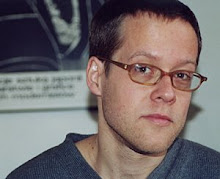
Laura Elrick & Barrett Watten, Poetry Project, 3/17/04
Laura Elrick read from a new, longer sequence called Fantasies/Impermeable Structures
32 line, 32 stanza structures. Modeled on 32 bar song structures?
"both the object seen and I that sees"
Started with quiet almost introverted reading style, and gradually warmed up into a more dramatic, declamatory style.
18th/19th century voicings as in recent Jennifer Moxley or Lisa Robertson.
Iambic riffing.
Focus on issues of social justice and subjectivity.
"here's where I commodify my sorrows"
"life with partially-hydrogenated declaration"
Brief portrayals (Reznikov?) and Susan Howeish vocab constructions and blurring
"I wear my sleeve on my heart"
"on the grassy knoll of good PR"
Unique feeling of public/private institutional / internal spaces in which mutually-leaking containers filled with the problems of class warfare and artistic representation mix.
-----
Barrett Watten did a two hour PowerPoint presentation about his own poetry with readings of his poems, and interpretations of and commentary on his own literary history.
I guess it would be possible to dismiss this performance as an outrageous act of self-absorption. Whether this is healthy or not, I'm not sure, but I found the whole thing interesting. One important point of reference was my memory of Bob Grenier's slide presentations in San Francisco, where he discussed his own hand written poems, often talking for extended periods about how a particular letter E was trying to become a letter A and so forth, performances I loved for their craziness and outrageousness. Breton is also, obviously a model here. I tend to like multi-media genre-mixing and almost anything that departs from the standard podium reading.
Watten showed a photo that one of the poems from Bad History is based on, an anonymous Korean shop owner during the '92 LA riots shot from the back as he points his gun to unknown targets outside the frame of the photo-- a photo pushing into Gustony cartoonish abstraction. Watten basically implied that what we're seeing here is actually an image transforming into a module or machine used by power the purpose of which is to destroy information about violence while transmitting representations of it. He didn't come out and say this, but I assumed he was implying that the result of this is to make the conception of violence and it's place in history a kind of digestible abstraction that obviates the more important layers of meaning which would have to be dealt with in a representation that included undeniable particulars, particulars which would inevitably draw the perceiver of the photo into the problematics of the historical scene, into the nets of power and meaning evoked there, and into questions of the viewer's own place in these things. There were several moments like this in the talk where I thought focusing on more basic elements of the issues brought up would have made the performance less daunting and more engaging. As Watten went into increasing nuance and complexity on issues of psychology, representation and power, I kept reasserting basic questions to myself that he was invoking be not addressing -- here esp. the issue of intra-class conflict between the immigrant shopkeeper and the rioters.
Interesting sequence starting with a photo of a car being manufactured, looking exactly like a HR Giger painting. Watten read a description of a car manufacturing area where the identification with these capitalist production means was allowed to come through unrepressed, which was then countered with a quote from the book Rivethead about the destructive triviality of the manufacturing process.
Describes Ford's insight that paying the workers enough to buy the cars is a kind of feedback.
Describes the fantasy that the negativity of profit is loss relative to development and production in the Detroit landscape. This was one of several times I thought of Foucault during this talk….the question what is your relation is to the constructive element of power systems…
Appropriately enough: The morning after the reading, on the C train on the way to work, I picked up a NY Post that someone had left on the seat. On page three was a story about how the CIA had Osama in their sights in 2000. Included was a photo, with a copyright NBC, apparently taken from a unarmed Predator spy plane, of Osama. The picture was nothing but a beautiful smear of abstract green and blue color areas with video pixilation bands.
3.19.2004
3.10.2004
3.06.2004
Wallace Shawn / Richard Foreman talk at CUNY Grad Center, 3/3/04
This moderated talk about theater was itself like a play, with Shawn exactly reprising his My Dinner With Andre character speaking very slowing and trying to work out something reasonable to say, and Foreman playing a perfect brilliant introvert character coming out with funny, provocative statements.
Foreman: "I have always hated theater."
Foreman suggested that working in theater has been appealing for him because it has allowed him to relate to other people in relation to his own fantasy life.
Foreman: "I like theater because it's real people and real stuff in front of you -- like life." He suggested that poetry is a contrast to this. He's thinking of Mallarme here? If I had stayed for the Q&A I would have asked why language isn't stuff or something in front of you. Later Foreman says his is a language based theater and I again wonder why the the presence language isn't like the presence of the actors or sets...
Both Wallace Shawn and Foreman discuss their respective relation to narrative. Shawn talks about having to have something to follow when he's seeing a play -- and that too much abstraction and lack of narrative create a situation where the play is like a sequence of abstract paintings. There problem with this, he says, is that you can take in an abstract painting very quickly. With abstraction in a play the first few "paintings" are interesting, and then his interest drops off steeply as the play goes on. He also talks about not liking narrative that is too obviously going for a verisimilitude that a theatrical performance can never create the way a movie can -- a character kicking the snow off his boots as he comes in the door, for example. Foreman says that in a film, his suspension of disbelief with the narrative is deep and almost automatic, and that in a play it never happens because the physical presence of the actors and sets destroys it for him.
Foreman spoke of a new play he's working on called "Pancake People" about internet culture and the general effects of information disbursal in the present era. This is something I think about a lot and feel is a important force operating on my generation of writers. I continue to wonder if we are in a period where the artistic phenomena are increasingly vertical (chordal) -- or that the vertical and the horizontal, the synchronic and diachronic are in the process of fusing.
The comically uptight moderator (unintentionally providing a great theatrical performance here) asks both of them how they start a play, a question which makes both of them uncomfortable and a little defensive, as though the maintenance of some kind of mystery in regard to the inception of the creative process is important to them. Foreman says he starts with "sentences" and Shawn says "sentences, including grammar."
The Moderator character asks about politics in plays and Foreman said the way he addresses politics is by exploring his own inner fascist in the plays. Shawn more or less concured and said "When I'm here talking to you or at dinner I'm a progressive guy, but putting the play together, I'm a progressive, I'm a conservative, I'm a fascist, etc. the whole spectrum..."
Foreman also relates this to being adopted and said, "I could have just as easily been adopted by the Bush family, and then I be like them!"
This moderated talk about theater was itself like a play, with Shawn exactly reprising his My Dinner With Andre character speaking very slowing and trying to work out something reasonable to say, and Foreman playing a perfect brilliant introvert character coming out with funny, provocative statements.
Foreman: "I have always hated theater."
Foreman suggested that working in theater has been appealing for him because it has allowed him to relate to other people in relation to his own fantasy life.
Foreman: "I like theater because it's real people and real stuff in front of you -- like life." He suggested that poetry is a contrast to this. He's thinking of Mallarme here? If I had stayed for the Q&A I would have asked why language isn't stuff or something in front of you. Later Foreman says his is a language based theater and I again wonder why the the presence language isn't like the presence of the actors or sets...
Both Wallace Shawn and Foreman discuss their respective relation to narrative. Shawn talks about having to have something to follow when he's seeing a play -- and that too much abstraction and lack of narrative create a situation where the play is like a sequence of abstract paintings. There problem with this, he says, is that you can take in an abstract painting very quickly. With abstraction in a play the first few "paintings" are interesting, and then his interest drops off steeply as the play goes on. He also talks about not liking narrative that is too obviously going for a verisimilitude that a theatrical performance can never create the way a movie can -- a character kicking the snow off his boots as he comes in the door, for example. Foreman says that in a film, his suspension of disbelief with the narrative is deep and almost automatic, and that in a play it never happens because the physical presence of the actors and sets destroys it for him.
Foreman spoke of a new play he's working on called "Pancake People" about internet culture and the general effects of information disbursal in the present era. This is something I think about a lot and feel is a important force operating on my generation of writers. I continue to wonder if we are in a period where the artistic phenomena are increasingly vertical (chordal) -- or that the vertical and the horizontal, the synchronic and diachronic are in the process of fusing.
The comically uptight moderator (unintentionally providing a great theatrical performance here) asks both of them how they start a play, a question which makes both of them uncomfortable and a little defensive, as though the maintenance of some kind of mystery in regard to the inception of the creative process is important to them. Foreman says he starts with "sentences" and Shawn says "sentences, including grammar."
The Moderator character asks about politics in plays and Foreman said the way he addresses politics is by exploring his own inner fascist in the plays. Shawn more or less concured and said "When I'm here talking to you or at dinner I'm a progressive guy, but putting the play together, I'm a progressive, I'm a conservative, I'm a fascist, etc. the whole spectrum..."
Foreman also relates this to being adopted and said, "I could have just as easily been adopted by the Bush family, and then I be like them!"
3.05.2004
Jack Kimball does short takes on Corina Copp, Mark Lamoureux, Allison Cobb, Michael Gottlieb, Tan Lin, Barbara Henning, K. Silem Mohammad, Albert Flynn DeSilver.
3.04.2004
Packed house at the Poetry Project for Michael McClure and Ron Silliman, last night.
Katie and I had been at the Richard Foreman / Wallace Shawn theater dialogue at CUNY grad center, where we ran into Cori Copp. We all split before the Q & A and jumped in a cab, getting to St. Mark's just as Larry Fagin was starting his introduction.
McClure, who I had never heard, read first. He went chronologically starting with his first poem published in a magazine (Poetry). Interesting sestina.
(when I hear the door creak of audience members coming in late, I always have to look -- what am I looking for?)
Stories of beat companions and a haiku about the light show at the Fillmore.
Sing song portraits of consciousness.
Read from Fifteen Fleas, which Larry Fagin edited and published as a stapled book for the reading. Startlingly flarfy work. Based to some extent on comic books. Lovely, energized swirls of insignificance.
"An animal is a mind."
"Be in comfort Chet Baker"
Ron Silliman started out by saying he was more interested in poetry than in poems.
Read from Albany
"I used my grant to fix my teeth"
Descriptions of public spaces / observations of homeless people / statements / puns / autobiographical elements pooling together and building as discrete units rather than strung into a story.
"I began to wonder… is Bob Dole… also … a Muppet"
"the essence of dance is fundraising"
I didn't get a chance to talk to Ron after the reading at the Telephone bar, but I found myself coveting his Howard Dean baseball cap.
Katie and I had been at the Richard Foreman / Wallace Shawn theater dialogue at CUNY grad center, where we ran into Cori Copp. We all split before the Q & A and jumped in a cab, getting to St. Mark's just as Larry Fagin was starting his introduction.
McClure, who I had never heard, read first. He went chronologically starting with his first poem published in a magazine (Poetry). Interesting sestina.
(when I hear the door creak of audience members coming in late, I always have to look -- what am I looking for?)
Stories of beat companions and a haiku about the light show at the Fillmore.
Sing song portraits of consciousness.
Read from Fifteen Fleas, which Larry Fagin edited and published as a stapled book for the reading. Startlingly flarfy work. Based to some extent on comic books. Lovely, energized swirls of insignificance.
"An animal is a mind."
"Be in comfort Chet Baker"
Ron Silliman started out by saying he was more interested in poetry than in poems.
Read from Albany
"I used my grant to fix my teeth"
Descriptions of public spaces / observations of homeless people / statements / puns / autobiographical elements pooling together and building as discrete units rather than strung into a story.
"I began to wonder… is Bob Dole… also … a Muppet"
"the essence of dance is fundraising"
I didn't get a chance to talk to Ron after the reading at the Telephone bar, but I found myself coveting his Howard Dean baseball cap.
3.02.2004
Caught some rare Orson Wells short films at Film Forum last weekend. A lot of magic act material, including Wells dividing Marlene Dietrich in half.
Thinking of why I have an instinctive dislike of magicians. I realized it hits the button with me where I'm pissed at the degree to which the world is fixed, rigged…. Also wondering how much of any art is a sequence of tricks…?
Thinking of why I have an instinctive dislike of magicians. I realized it hits the button with me where I'm pissed at the degree to which the world is fixed, rigged…. Also wondering how much of any art is a sequence of tricks…?
2.27.2004
2.25.2004
The Frequencies, Noah Eli Gordon, Tougher Disguises Press, 2003
I sometimes think of blogging as cross between writing a journal and hosting a radio show.
Noah Eli Gordon, in his first book The Frequencies, takes the writer-as-radio/DJ metaphor and rearranges it in dozens of combinations in a series of prose poems written from the perspective of a kind of DJ/poet/blogger. The poems veer between essay, dream-poem, and quasi-narritive.
Metaphors of broadcasting, sound and signal phenomenon are applied to many subjects, often personal relationships and questions of creativity.
"Is it charming to destroy silence? To glue the bits back together, to appreciate the possibility of selection, to talk with someone in line at the grocery store who gives the standard objection, says it's like a drop in the bucket, this wanting to be heard."
Many details associated with a radio are used to explore some subject matter -- for instance, a series of riffs on time are invoked with a clock radio.
“part suspect, part seduction”
Gordon does a lot with these elements -- light, fun, aiming to please and delivering. Wooing the reader.
Michael Friedman-like voicings crossed with Frank's Wild Years. Waits-esque vibe throughout:
“The station memos were full of roman numerals & everyone in the coliseum had their thumbs pointed down. The queen bee was drinking oil, thought the ticking in her ears was an engine.... Face it, we're all in love with landing gear.“
The few sections of repeated grammatical arrangement don't add much to the book, but there are very few of them.
He implies a lot more interesting material and thought than he develops, a kind of chord building made of implications and hints.
One sentence construction that he handles well is a run on sentence with an argument building tone that doesn't necessarily build an actual argument. This rhythm is combined with figure of speech and cliché mixing and juggling.
The most of this work has a funny, light touch, though Gordon will sometimes orbit closer to a more serious question:
“What we hear off the air is not the radio lying to us, but what we encode to come to terms with our own enclosure.”
There are moments where the identification reverses and the radio become a imitation of sound or a representation of the commercialization of sound, countered here by attending to live sounds coming through the window:
"The windows were open & I could hear people laughing from the roof. It was good. The bed was full. The radio was stiff & prim & explosively still."
I sometimes think of blogging as cross between writing a journal and hosting a radio show.
Noah Eli Gordon, in his first book The Frequencies, takes the writer-as-radio/DJ metaphor and rearranges it in dozens of combinations in a series of prose poems written from the perspective of a kind of DJ/poet/blogger. The poems veer between essay, dream-poem, and quasi-narritive.
Metaphors of broadcasting, sound and signal phenomenon are applied to many subjects, often personal relationships and questions of creativity.
"Is it charming to destroy silence? To glue the bits back together, to appreciate the possibility of selection, to talk with someone in line at the grocery store who gives the standard objection, says it's like a drop in the bucket, this wanting to be heard."
Many details associated with a radio are used to explore some subject matter -- for instance, a series of riffs on time are invoked with a clock radio.
“part suspect, part seduction”
Gordon does a lot with these elements -- light, fun, aiming to please and delivering. Wooing the reader.
Michael Friedman-like voicings crossed with Frank's Wild Years. Waits-esque vibe throughout:
“The station memos were full of roman numerals & everyone in the coliseum had their thumbs pointed down. The queen bee was drinking oil, thought the ticking in her ears was an engine.... Face it, we're all in love with landing gear.“
The few sections of repeated grammatical arrangement don't add much to the book, but there are very few of them.
He implies a lot more interesting material and thought than he develops, a kind of chord building made of implications and hints.
One sentence construction that he handles well is a run on sentence with an argument building tone that doesn't necessarily build an actual argument. This rhythm is combined with figure of speech and cliché mixing and juggling.
The most of this work has a funny, light touch, though Gordon will sometimes orbit closer to a more serious question:
“What we hear off the air is not the radio lying to us, but what we encode to come to terms with our own enclosure.”
There are moments where the identification reverses and the radio become a imitation of sound or a representation of the commercialization of sound, countered here by attending to live sounds coming through the window:
"The windows were open & I could hear people laughing from the roof. It was good. The bed was full. The radio was stiff & prim & explosively still."
2.24.2004
Thoreau's preoccupation with the parallel forms displayed in leaves and in ice crystals led him to suggest a kind of early theory of everything based on leaves. This same observation would be fully articulated, in the 1970s and 80s, in fractals -- self-similarity.
Thoreau is often at his most fascinating at these points where a quasi-mystical theme wrestles itself completely free of its metaphysical connotations and becomes a fusion of empirical observations, speculation about consciousness, and poetic, intuitive leaps. The Journals are full of variations on this pattern.
He is investigating the self-similarity patterning of consciousness and attention interacting with high-detail observation and multiple simultaneous layers of theme and subject matter?
Interesting to get his impressions of New York City when he spent nine months in Staten Island in his mid twenties trying to make it as a writer. The blur of faces. Also the similarities of elements of his bio to many writers I know. The college years, the early affinities and imitaions, the historical forces, the critical alliances, the lack of ways to earn money, the disappointments, developments, growth and decisions. You have to wonder about the patterns of how our live as writers pan out and how much of it might also be described with fractals....
Thoreau is often at his most fascinating at these points where a quasi-mystical theme wrestles itself completely free of its metaphysical connotations and becomes a fusion of empirical observations, speculation about consciousness, and poetic, intuitive leaps. The Journals are full of variations on this pattern.
He is investigating the self-similarity patterning of consciousness and attention interacting with high-detail observation and multiple simultaneous layers of theme and subject matter?
Interesting to get his impressions of New York City when he spent nine months in Staten Island in his mid twenties trying to make it as a writer. The blur of faces. Also the similarities of elements of his bio to many writers I know. The college years, the early affinities and imitaions, the historical forces, the critical alliances, the lack of ways to earn money, the disappointments, developments, growth and decisions. You have to wonder about the patterns of how our live as writers pan out and how much of it might also be described with fractals....
2.16.2004
Jack Wright (sax) and
Reuben Radding (bass), COMA series @ ABC No Rio
Beautiful saxaphone/ bass duet with combinations of negative space, forward momentum and focused self-control, often all at the same time.
This was a half hour of music played almost exclusively with extended technique. The dynamics were mostly quiet, and it's great to be able to listen to acoustic music at close range with no brittle PA in the almost shockingly low-noise ceiling environment offered by a frigid winter night on Rivington St.
There's something about the way Radding and Wright play together that foregrounds the shapes of the collective pauses, the negative space, which, in a way, is the most deeply collaborative musical element at play.
Reuben Radding (bass), COMA series @ ABC No Rio
Beautiful saxaphone/ bass duet with combinations of negative space, forward momentum and focused self-control, often all at the same time.
This was a half hour of music played almost exclusively with extended technique. The dynamics were mostly quiet, and it's great to be able to listen to acoustic music at close range with no brittle PA in the almost shockingly low-noise ceiling environment offered by a frigid winter night on Rivington St.
There's something about the way Radding and Wright play together that foregrounds the shapes of the collective pauses, the negative space, which, in a way, is the most deeply collaborative musical element at play.
2.15.2004
Five Easy Pieces, Bob Rafelson, 1970
A prodigal son story about the alienation of an underachieving upper-class trade-down. The film is a sieve though which partially digested information about class identity and dynamics pours.
It’s possible to feel the director’s life coming through the film from the first shot, with careful nuanced character renderings, subtle dialogue, scene arrangement and cinematography. Odd to think of this director as the creator of the Monkeys.
Rafelson is good with text. The scene where Nicholson sleeps with Sally Struthers ends with a shot of him wearing a TRIUMPH motorcycle t-shirt. In the last shot, where Nicholson abandons his pregnant wife, the blocking includes the word MEN from the outside bathroom for the entire shot.
He's also good with machines and cars, which are picked out and shot with as much care as the people. He likes to put objects between people, like a cigarette machine. Nicholson is immediately handed a sewing machine in the sequence where he and Karen Black give a hitchhiking lesbian couple a ride. In this scene, which is intensely comic, Helena Kallianiotes so commands the manic dirt-obsessed character and takes so much joy in the portrayal that the rest of the movie screeches to a hilarious halt for the entire time she is on screen.
Great sound moment when Nicholson plays the horrendously and beautifully out-of-tune truck piano and it mixes with the horns of the traffic jam.
There is an interesting mix of class languages and scenarios, though there are never any overt questions of class conflict. The estrangement information is only rendered in the small details of an impossible individual escape from a pretentious, bogus upper-class elite to a frustrated, unaware working class. This is a movie about rebelling against pointless rules and not fitting into any class identity that has spilled over into a partial rendering of the general American aphasia of class estrangement.
A prodigal son story about the alienation of an underachieving upper-class trade-down. The film is a sieve though which partially digested information about class identity and dynamics pours.
It’s possible to feel the director’s life coming through the film from the first shot, with careful nuanced character renderings, subtle dialogue, scene arrangement and cinematography. Odd to think of this director as the creator of the Monkeys.
Rafelson is good with text. The scene where Nicholson sleeps with Sally Struthers ends with a shot of him wearing a TRIUMPH motorcycle t-shirt. In the last shot, where Nicholson abandons his pregnant wife, the blocking includes the word MEN from the outside bathroom for the entire shot.
He's also good with machines and cars, which are picked out and shot with as much care as the people. He likes to put objects between people, like a cigarette machine. Nicholson is immediately handed a sewing machine in the sequence where he and Karen Black give a hitchhiking lesbian couple a ride. In this scene, which is intensely comic, Helena Kallianiotes so commands the manic dirt-obsessed character and takes so much joy in the portrayal that the rest of the movie screeches to a hilarious halt for the entire time she is on screen.
Great sound moment when Nicholson plays the horrendously and beautifully out-of-tune truck piano and it mixes with the horns of the traffic jam.
There is an interesting mix of class languages and scenarios, though there are never any overt questions of class conflict. The estrangement information is only rendered in the small details of an impossible individual escape from a pretentious, bogus upper-class elite to a frustrated, unaware working class. This is a movie about rebelling against pointless rules and not fitting into any class identity that has spilled over into a partial rendering of the general American aphasia of class estrangement.
2.14.2004
The audience at poetry readings is comprised almost completely of other poets. Is it that only other poets can digest poetry because we have developed four stomachs or is it simply that there's no money behind it?
The quickest glance at the art world implies the latter. When I remember seeing U2 in a stadium in Philadelphia in the mid-eighties, though, I can't help but think that the entire audience was comprised of rock stars.
The quickest glance at the art world implies the latter. When I remember seeing U2 in a stadium in Philadelphia in the mid-eighties, though, I can't help but think that the entire audience was comprised of rock stars.
Subscribe to:
Posts (Atom)