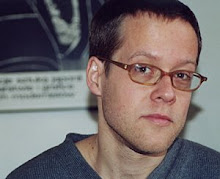
Peter Gizzi, talk on Jack Spicer. Poet's House 5/6/04
I came in late to this talk as Peter was discussing After Lorca. It occurred to me that having Lorca introduce you is a great deflationary comical rearrangement of Whitman's "stealing" his introduction from a private letter of Emerson's without asking him for permission. Could Spicer be considered a negative or reversed transcendentalist? My mind kept going back to the arena of poetic social manifestation were the poet attempts to associate their work with artistic status figures…. what is this process? What does it reveal?
Gizzi in this talk made a pitch to see Spicer as a traditional poet in the good sense, that is -- keeping basic poetic gestures alive (by morphing them) in one's time and according to the demands one's experiences in the world call for. Great to have Spicer described not as some magically depressed hermeticly private crank, but as a reflection of the larger history happening around him.
Discussion of basic Spicer moves -- puns, degraded sources, etc., leading up to a comparison of Spicer with California funk art and assemblage, and, in particular, Bruce Connor.
Gizzi showed the Connor film Report, which was totally riviting. Repeated (sampled you could say) news images of the Kennedy assassination that never get to the actual moment of violence, but seem to be infinitely approaching it. Against this disorienting permanent deferment of the moment of truth a news voiceover continues uninterrupted, the temporal continuity of public language seeming to flow and change even as historical meaning is frozen. I thought more than once of Sept. 11th, and the nightmarish media repetition than followed.
I felt in the audience a fascinating rift between the older audience members who had lived through the assassination and the younger ones to whom it is all more distanced media and myth. The older man sitting in front of me kept shaking his head and quietly saying, "why…why…" not understanding what this has to do with Spicer or why a filmmaker would do such a thing.
More than once I thought of JG Ballard during the course of this film, and I realized there may be strong connections between Ballard and Spicer… the use of repeated media/myth images and their fetishistic aspects, the deflationary use of this material which also invokes the dynamics of individual fixation that these myth/history/image systems involve.
Talking with Steve Evans afterwards we both agreed that the deflationary power of Spicer's work is one it's most valuable qualities.
The poetic movement not from unknowing to knowing, but from believing to not knowing? Not art that destabilizes myth but art that reveals an unstable reality from beneath a myth, or, one could say, a wish for stability.
5.19.2004
5.15.2004
It's hard to imagine that the patriotic denial of national guilt is stronger anywhere in the world than in the USA now, esp. relative to the ostensible level freedom of speech we're suppose to have here. And esp. considering that we could just be getting started with this neo-imperialist shit. This is something traditional that happens in all countries with power, because patriotism, along with it's sibling, religion, are the primary ways leaders switch off the critical thought of the population in order to exploit them, and to use them to exploit others. (my thoughts return to the obvious again!) So it's been for 2000 years with empires, but I do think the USA has cornered the market!
Our corporate media broker state apparatus themselves broadcast these picture of war crimes day after day and Bush's approval ratings stay the same. Rumsfeld's defense is basically that war crimes are no big deal, and people should shut up about it -- he should be able to do as he pleases without the interference of "the world" knowing what he's doing. As if we could hide the meaning of our actions from anyone except ourselves!
There must obviously be guilt in the population (of the paralyzing variety not of the "okay now how are we going to make it right" variety), but it goes with an equal helping of denial. Paralyzed /unprocessed guilt and denial, those are two great American tastes that go great together. The current leaders are clearly beyond the reach of guilt feelings -- these people are expressions of narcissistic tendencies so extreme that guilt is no longer a possibility.
Our guilt about the history within the USA, which is about genocide against Native Americans, the enslavement of Africans, and the cast system and repression of our underclass, all operate here in a strong but deeply sublimated domestic guilt/denial system. The powers of denial here are ten times stronger than the powers of guilt as conscience. In the USA, morality operates as an opinion you have about others, it's not something you would apply to what you actually do, or to what "your country" does.
Americans, on the surface, are infantile in their understanding of what it's leaders are doing and why. We look for images of fathers in a president, trust our government, and we "get mad" at people in other countries when they "don't like us." That's how many Americans think. We're not stupid. This is a tactical suppression of intelligence.
American guilt is a guilt that makes us more violent. We think -- what if somebody tried to do this shit to US? We'd want to kill them and torture them. So then we have to be more violently repressive towards them because we're afraid they would want to kill us as much as we'd want to kill them in the same circumstances. That's how the real white guilt works.
It seems that only in academia is historical guilt allowed to be a topic of conversation for extended periods. Because it is contained there, like a protest march route set by the NYPD is contained. When Goering has his own show on Fox the topic is not going to be historical guilt. "You're just having white guilt" means shut up. It's a reactionary statement. I have to admit, though, that saying "we are all complicit " and just leaving it at is a drag and rings false. If it's not elaborated on it can come off as saying "please watch me wringing my hands."
The guilt incurred through imperial repression of other countries is not quite on the mental radar of Americans yet , though I think we project our domestic guilt onto foreign others. The Abu Ghraib prison pictures are reminiscent of American lynching photography. Think of the treatment of Aber Louima got in jail after being falsely arrested in New York City.
Will these fragmented country/ gulag zones be allowed to flourish? Will they grow? The pictures show a tiny sliver of what's going on over there. They also show just a tiny lighted corner compared to a lot of the things we know about foreign policy/CIA/MI history and what it was done over the past 50. America has been such a quick learner. We were able to learn so much from the Nazis and their innovative ideas about counter-insurgency, and to make sure that that Nazi culture didn't die out, didn't go to waste after WWII.
When Rumsfeld was questioned on the armed services committee was very angry about digital photography, and how easy it is to distribute. He was complaining about this when he was being questioned about why 60 minutes was asked not to show the pictures. This was his main concern.
Funny, I remember all these newspaper articles about the digitizing of photography when it was just starting years ago, how it would mean that no one will be able to believe media or history anymore. Looks like it (combined with networking of computers) is going to have the opposite effect. Information leakage may be a lot harder to contain than the Bush team thought. You can bet they will now redouble their effort to control it now.
5.10.2004
5/1/04 4:30
Deirdre Kovak, Kamau Braithwaite, Bowery Poetry Club
Deirdre Kovak
Strong sound-based orientation. Dense, meticulously controlled phrases and sentences carefully smashed together, operating in a intentionally attenuated spectrum of variation, not unlike Bruce Andrews in these respects.
"love it or leave with it"
Much deadpan humor and riffing off of self-discomfort and social discomfort in a look / look away pattern.
"The lack of siblings has contributed to my lack of emotional growth."
"Smoking is not speech."
It feels as if the negative psychic energies of living on this side of empire are being transformed into something constructive, a persona processing system mowing itself down in a sequence of downwardly curved starts none of which, in and of themselves, are allowed to develop, but which nonetheless build into larger thematic images. Information, energies and structures emanate as this system is pummeled with gobbets of decaying contradictory truths.
"like your hand against the squeamish of history"
"tomorrow is touching itself in public
"heaven is a do-over"
Kamau Braithwaite
The excavation of history from one's present moment is epic poetry is it not?
"it it it is not. It is not enough to be. To be free of the red white and blue."
Drumming lightly on the table. Half sung.
"to be semi-colon, to be semi-colony"
"95% of my people poor. 95% of my people black. 95% of my people dead."
This poetry moves beautifully away from mysticism. The necessary opposite of mystery. The articulation of why we have trouble understanding.
"there is an absence of truth, like the good tooth drawn from the skull"
"out of the Coney Island of our mindless architects"
"this perturbation that does not signal health"
Halfway through this increasingly riveting reading, Braithwaite went into an extemporaneous explanation of the origins of the Limbo dance, that it comes from the torture of the middle passage, the vertical space of the slave ship decks. How during the dances the tourists always bend over forward, the easy way, not understanding. Braithwaite's reading was so patiently developed that his story telling skills snuck up on me at this point in the reading, before I even realized what was happening. The story and improvised explanatory information fused beautifully and powerfully with the overall body of poetry being read. It felt not like an interruption of the poetry, but like the opening of a related dimension.
"to negotiate this passage and rise on the other side,
rise like the sun to the wonderful glow of the drums."
5.09.2004
5/1/04, 3:00
Sound Cube, Charles Morrow, The Kitchen.
Short pieces by Olivia Block, Nicola Green, Shelley Hirsch, Martyn Ware/Vincent Clark, Miya Masaoka, Steve McCaffrey, Charles Morrow, Phill Niblock, Michael J. Schumacher, Scanner, Stephen Vitiello, and Pamela Z .
A sound cube is a three-dimensional multi-channel surround sound system, a frame holding eight speakers. There were two separate cubes here, one with enough room for about 15-20 people, another smaller one, with room for 6 or so. With this system, the sounds can be positioned and moved anywhere within the cube, vertically and horizontally. The larger cube made for a more communal listening experience, and the smaller one had sharper sound images, because there was less reflection. The best possible position for clarity of image was for a single listener sitting on the stool in the center of the smaller cube. The tension here between clarity of sound image and space that allowed for social listening was interesting. The social connotations of reverb….
Phil Niblock
Beautiful, thick, undulating drone. Slow microtonal variations in the drone layers. This piece was ending just as I came in, so I didn't get a sense of the how the sound cube and 3-D positioning was interacting with this signature Niblock sound.
Charles Morrow
Not surprisingly, this piece best captured the feeling of object three dimensionality the sound cube is capable of representing. Sawing wood, tapping sounds. Vivid feeling of the substance of wood.
Shelley Hirsch
A kind of sound theater/installation poetry. Back yard sounds, connotations of suburban childhood. Mouth sounds.
Scanner
Also used backyard sounds. Riffing off remembered suburban sound space. Yard/space art/space. containment. Birds / synth tones.
Stephen Vitiello
Mesmerizingly beautiful organ tones mixed with particle movement sounds. Gravel sliding off a metal surface. Tonality and texture mixed, as with many of these pieces. The sound of tarps being pulled over wood. Digital delay.
Miya Masaoka
Sounds recorded from a three-dimensionally mic'd koto, as though the listener were inside a giant koto. Eight microphones on a single instrument. Texture sounds, scrapes and taps. Small-scale timbre sound events and drone.
Steve McCaffrey
A marvelous digital arrangement by Charles Morrow of McCaffrey's poem Cappuccino, in which words are taken from mathematical language and given Italian suffixes. Here his voice has been multi-tracked, spacialized and looped -- a single voice recording made into a percussion orchestra, Varese-like rhythmic structuring and development.
Nicola Green
Layers of laughter panning around. Most interesting when there was a overlapping of several layers of laughter. The decontextualization of laughter from the source of humor created an odd drama. Are we being laughed at? Is the laughter sincere? What made this person laugh? Who are these people? Henry, Katie's parrot, almost always considers laughter as a musical event worthy of a response, even laughter on the television or radio. He can imitate it quite well.
Had to leave before I got a chance to hear all the pieces. Adeena and I bumped into Charles Morrow on the way out, said hi, and jumped in a cab to go hear Deirdre Kovac and Kamau Brathwaite read at the Bowery Poetry Club.
5.08.2004
Breeze, John Latta
Themes and thoughts in a connective tissue of images. Closely controlled almost formal feel. Frank O'Hara / Robert Duncan echos.
Latta gives equal importance to following perceptions and to following the shapes of the poem's construction and associative turns, even when these elements come into conflict.
"rhythm, unavoidable, makes a ratio"
A few separate modes at work here, I prefer the lighter poems that juggle particulars, rather than the ones that come to conclusions.
Interestingly uncomfortable and distinctly crafted rapture-textures.
At moments the poems push into an almost mystical over-expansiveness as a way of resolving tensions, just when I'm wanting him to go deeper into the tensions....
"lines of distress and conjecture"
4.29.2004
Hank Lazer's The People's Poetry
Lazer talks about some good things here, like Susan Schultz, Walter Lew, internet writing and publishing as possibly constructive reversals of globalizing infrastructure. He makes an attempt at addressing rap and spoken word (though in embarrassing uncle mode, ugh!), and goes out of his way to discuss neglected writers like Taggart, Enslin. He talks about Maria Damon! It's clear he's genuinely interested in asking questions about what the present situation is in poetry.
More importantly, he gropingly sees the idea of _dispersal_ as being possibly constructive. He is not even close to understanding the depth of the paradigm shift he is glimpsing out of the corner of his eye. He nervously reverts to mostly giving shout outs to Language poets who are already very well known and widely influential.
When discussing younger writers, this otherwise interesting essay becomes questionable. There seems to be some defensive gravitational impulse that keeps him from escaping triumphalist generationalism, though I would add that he's hardly the only established writer to have this problem:
_A major hazard for this generation is a bland eclecticism, with technically adroit writing that remains superficial because the cultural and historical tension of the formal gestures has evaporated._
If these gestures now lack historical tension (meaning it is no longer the 70s and early 80s?) then he is complaining that young writers sound too much like language poetry and that this doesn't work any more because those gestures only had a political meaning during the Ford, Carter and Reagan administrations? Would this mean the Lazer considers himself and his contemporaries to have at some point (in the mid 80s?) to have stopped writing in the present? He would then be advocating completely different gestures (direct contextualizations I assume, and think he's hinting at) that operate in present political context of the 90s and 00s? Gestures that poets of his generation are not making, even though they are working in the same period?
Or does he mean that only work that repeats Language Poetry's formal gestures AND framing propositions is valid? That _their_ work is _pure_ (his word) and that _younger writers_ are adulterated?
This seems like a hasty recycling of statements from Lyn Hejinian's famous Rain Taxi interview. My most cynical read on this is the possibility that this kind of statement is intentionally picking out some Iowa workshop / Jorie Graham imitators (work which actually IS confessional poetry with spray-on coating of Language Poetry) and ingenuously saying _look the kids aren't any good, we're the real deal_ as a generational PR move, ignoring the interesting younger writers. Lazer may actually not know about the existence of much writing by poets 20-40.
Or is this kind of statement just a temporary thing -- a presently incoherent conflicted response to a group artistic mid-life crisis?
4.21.2004
The night beacon of the lighthouse pulsating in the darkness. Giant bands of glowing fog-light turning through space every ten seconds.
Pigeon Point. Named for the wreck of the Carrier Pigeon. This was a good spot for shipwrecks and rum-running, for the same reason.
Oil lamps and Fresnel lens -- 1872. 1,008 brass-framed prisms to concentrate the source of light. Joined together to form a six-foot-diameter in a circular frame.
Now a 1,000-watt light bulb.
When the steam whistle first blew, cows from a nearby ranch stampeded to the beach. "The cows must have thought there was a very wonderful bull down there."
1970's, the signal was automated.
The night sky, fog moving under stars.
4.18.2004
Butano State Park. Coastal Redwoods. Damp and dark at the stream basin. Areas of thick underbrush and overturned redwood trees. Steep slopes and moist, thin topsoil. Not the tallest redwoods but still big enough to be micro-environments in and of themselves. Ferns growing on branches 100 feet up. Purple Iris'.
An economy of sunlight, with the tallest trees taking the most and the animals and plants who dig moisture and shade thriving at the bottom. Some of the lower areas are only redwoods and ferns. Prehistoric looking. Banana slugs, moss, spiders in rotting, upturned root beds.
Going up the ridge. Small desolate areas of terminal Douglas fir forest. Dead trees that choked off their own light -- renewal cycle sustaining them in the overall balance and long term coherence of the forest's symbiotic mechanisms.
Hot, flat fire road with sunlight enough to sustain poppies. A relief to start back down the trail into the cool, moist air and complexities of the mixed Douglas fur and Redwood areas. Sharp patches of sunlight filtered though branches. Unusually quiet. Recent burn marks around the trees -- everything here evolving around the fires. Improvising to turn destruction into something good.
I love the chaos and order mixed together. Are these state park enclosures preserved areas of nature? Or are they now art?
4.17.2004
Pescadero, ala trout fishing spot, classic tiny old west town crossroads but with New England architecture. Used to be a seaside resort on the stage coach route.
We arrive at our resort, Coastnoa, Right up against Butano State Park.
Mix of tent areas, cabins, rooms and common areas. Young couples and families. Lightly streaming tinges of anger beneath the crunchy veneers.
Fire place in the room. Duraflame logs provided. Wax and sawdust. I take an interest in Duraflame as a take on content. Their motto is the secret of fire.
Half Moon Bay. Pleasant small town. Crunchy yuppie stuff and child rearing scenes. Katie's friend Stephanie grew up here, living on a boat.
Picked up, to my surprise, a used copy of Georg Lukacs, The Historical Novel, in the used book store here. Marked up only in the first chapter.
Excellent, strong coffee available every ten yards. Why did the culture of strong coffee never develop in the East? Must be the French/Italian take on eating, which involves taking time to enjoy one's food, never happened in the East, esp. New York City, where food is quickly shoveled into one's mouth as you earn money or race toward the next marker. That, or eating is an excuse to be seen in a status-generating/reinforcing room, where one waits to enter, and is then rushed out like an item in a factory.
NYC has a dispiriting, corporate-dork Starbucks every two blocks, but does not have anything like the coffee culture of the west coast. The East Village has many small coffee shops that survive, not one of which has coffee one tenth as good as an average place the Bay Area. Not exactly about coffee. It is about whether there is an expectation that one is ever suppose to feel that they are abiding within their own duration, even for a small stretch. In the culture of NYC this feeling would be taken as a sign of weakness.
4.14.2004
Space of pacific coast highway 1, the realized dream of Dr. John L. D. Roberts. An incredible artwork, though one build by prisoners etc. 1919-1937. Pacific ocean and lush farmlands right up against each other, flowers and vegetables. Limestone cliffs.
The total lack of commercial signs. No McDonalds. No Billboards. Because of policies. Ecologically unsound road repair methods let in destructive nonnative plants, Pampas Grass. Unbelievable feeling of freedom and space on this road. Curving and extending. And the air so full of information -- compared to the unbreathable stuff we use for oxygen in NYC.
San Gregorio State Beach, south side. Old Ohlone village. Estuary and freshwater marsh. No egrets today. Crumbling cliffs and expanding views. The combinations of types of erosion here, sea water, creek water, wind, create a particular variety in the contours of the limestone and shallow topsoil. I remember seeing humpback whale flukes come out of the water right at the beach here years ago. A little girl pointing and screaming in delight and fear.
The cliff line looks like a turkey on a slicer. The Red-winged Blackbirds doing legato notes with a curious timbre. Bright orange shoulders. The sound a combination of machine and cat. Excellent group riffing.
Sparkling early evening sunlight on ocean waves.
4.13.2004
California Notes
Flying into SF at night. Black area of bay water. The negative space of man-made light. Water, not development.
San Bruno extension of airport. Connecting transport structures imposed over older small CA town.
San Bruno Regency Inn motel, the room smelling faintly of melted plastic. The details, a perfect piece of installation art about accommodation and alienation, a space created for people to not actually be there, but to be contained and seen to, a bit like the alien studio suite at the end of Kubric's 2001, A Space Odyssey, but of course without the appropriated poshness. The awkward attempts of the aliens to provide a living space, the subtler connotations of which they wouldn't be concerned with. The class implications of the expensive furniture transplanted onto another planet creating much of the alienating upper-class human-pet-hospital-through-the-eyes-of-other-beings vibe.
Low flying airplane sound at night. Amazing bass and treble layers sliding away from each other in the sustain. The depth of the partials. The implied power of the engines a bit too close. Nervousness charged into the sound, beautiful.
4.04.2004
Will Alexander, Bowery Poetry Club, 4.3.04
Missed Harryette Mullen, but arrived in time to see Will Alexander's whole set. He read with an electric guitar player, who improvised with loops and textures.
Alexander read with the same style and pacing as he normally would without the music, so the overall arrangement was in the free jazz tradition of streams of separate things happening at the same time in phenomenological polyphony. The poetry was read blastissimo, without breaks or pauses, and the guitar player essentially took a supportive role. The music added a lot to the overall performance energy, and I thought there could easily have been a whole band here, at least bass and drums in addition to guitar.
Alexander's poetry is thought provoking and extremely vertical, with vocabularies building and massing into color areas. You could think of this performance a duet for two harmonic instruments. I experienced it as a movement through space, with cloud and particle formations of vocabulary spiraling past. The guitar player also implied movement through a sound space that could have been considered very small or very large, esp. in his loop sequencing.
Alexander's syntax is fairly static, with constructions that fall into an elevated surrealist argument / description voicing. This static syntactical element is a stable structure around which the vocabulary structures are built dynamically (though this dynamic quality happens within a fairly controlled set of registers). The word groups tend to fall within several sets of concerns -- environments, animals, minerals, elements, and mental states. The words pile up with only ostensible syntactical exchange. The vocabulary sequences, and their implied subject matter, linger way past anything suggested by the actual sentence structures, like:
levels / vertigo / hummingbird / omniscience / nostalgia.
Almost any of the words from these concern-sets can be and are plugged into the syntax grid, and this comes off almost as a proposition about ranges freedom within agreed-upon formal arraignments.
It is impossible to even scratch a doodle onto a scrap of paper without invoking the question of what identifiable parts of the past still have a claim upon us. Alexander addresses this question by actively joining in dialogue with the works of Aime Cesaire. I guess it could be argued that anything identifiable as a claim from the past that one could pick to attend to on the basis of one's own tropisms is already more of a function of what we think of as the present, and the more crucial aspect of the past are those things which also have some kind of claim on us but which we are incapable of seeing at present.
Alexander's work also operates as a perpetual motion machine whose function it is to reject any external definition or limitation of identity or experience while refusing to posit an alternative except the ambient motion and particle phenomenon that seem to go along with and exist as the very substance of this rejection. It felt like the embodiment of the wish to be completely uncontained, hence the impact of the work feels ambiant and spatial. The rebellious, speculative, and of course, impossible quality of this embodiment are so obviously related to the work of Sun Ra that I won't belabor the obvious here.
3.19.2004
Laura Elrick & Barrett Watten, Poetry Project, 3/17/04
Laura Elrick read from a new, longer sequence called Fantasies/Impermeable Structures
32 line, 32 stanza structures. Modeled on 32 bar song structures?
"both the object seen and I that sees"
Started with quiet almost introverted reading style, and gradually warmed up into a more dramatic, declamatory style.
18th/19th century voicings as in recent Jennifer Moxley or Lisa Robertson.
Iambic riffing.
Focus on issues of social justice and subjectivity.
"here's where I commodify my sorrows"
"life with partially-hydrogenated declaration"
Brief portrayals (Reznikov?) and Susan Howeish vocab constructions and blurring
"I wear my sleeve on my heart"
"on the grassy knoll of good PR"
Unique feeling of public/private institutional / internal spaces in which mutually-leaking containers filled with the problems of class warfare and artistic representation mix.
-----
Barrett Watten did a two hour PowerPoint presentation about his own poetry with readings of his poems, and interpretations of and commentary on his own literary history.
I guess it would be possible to dismiss this performance as an outrageous act of self-absorption. Whether this is healthy or not, I'm not sure, but I found the whole thing interesting. One important point of reference was my memory of Bob Grenier's slide presentations in San Francisco, where he discussed his own hand written poems, often talking for extended periods about how a particular letter E was trying to become a letter A and so forth, performances I loved for their craziness and outrageousness. Breton is also, obviously a model here. I tend to like multi-media genre-mixing and almost anything that departs from the standard podium reading.
Watten showed a photo that one of the poems from Bad History is based on, an anonymous Korean shop owner during the '92 LA riots shot from the back as he points his gun to unknown targets outside the frame of the photo-- a photo pushing into Gustony cartoonish abstraction. Watten basically implied that what we're seeing here is actually an image transforming into a module or machine used by power the purpose of which is to destroy information about violence while transmitting representations of it. He didn't come out and say this, but I assumed he was implying that the result of this is to make the conception of violence and it's place in history a kind of digestible abstraction that obviates the more important layers of meaning which would have to be dealt with in a representation that included undeniable particulars, particulars which would inevitably draw the perceiver of the photo into the problematics of the historical scene, into the nets of power and meaning evoked there, and into questions of the viewer's own place in these things. There were several moments like this in the talk where I thought focusing on more basic elements of the issues brought up would have made the performance less daunting and more engaging. As Watten went into increasing nuance and complexity on issues of psychology, representation and power, I kept reasserting basic questions to myself that he was invoking be not addressing -- here esp. the issue of intra-class conflict between the immigrant shopkeeper and the rioters.
Interesting sequence starting with a photo of a car being manufactured, looking exactly like a HR Giger painting. Watten read a description of a car manufacturing area where the identification with these capitalist production means was allowed to come through unrepressed, which was then countered with a quote from the book Rivethead about the destructive triviality of the manufacturing process.
Describes Ford's insight that paying the workers enough to buy the cars is a kind of feedback.
Describes the fantasy that the negativity of profit is loss relative to development and production in the Detroit landscape. This was one of several times I thought of Foucault during this talk….the question what is your relation is to the constructive element of power systems…
Appropriately enough: The morning after the reading, on the C train on the way to work, I picked up a NY Post that someone had left on the seat. On page three was a story about how the CIA had Osama in their sights in 2000. Included was a photo, with a copyright NBC, apparently taken from a unarmed Predator spy plane, of Osama. The picture was nothing but a beautiful smear of abstract green and blue color areas with video pixilation bands.
3.10.2004
3.06.2004
Wallace Shawn / Richard Foreman talk at CUNY Grad Center, 3/3/04
This moderated talk about theater was itself like a play, with Shawn exactly reprising his My Dinner With Andre character speaking very slowing and trying to work out something reasonable to say, and Foreman playing a perfect brilliant introvert character coming out with funny, provocative statements.
Foreman: "I have always hated theater."
Foreman suggested that working in theater has been appealing for him because it has allowed him to relate to other people in relation to his own fantasy life.
Foreman: "I like theater because it's real people and real stuff in front of you -- like life." He suggested that poetry is a contrast to this. He's thinking of Mallarme here? If I had stayed for the Q&A I would have asked why language isn't stuff or something in front of you. Later Foreman says his is a language based theater and I again wonder why the the presence language isn't like the presence of the actors or sets...
Both Wallace Shawn and Foreman discuss their respective relation to narrative. Shawn talks about having to have something to follow when he's seeing a play -- and that too much abstraction and lack of narrative create a situation where the play is like a sequence of abstract paintings. There problem with this, he says, is that you can take in an abstract painting very quickly. With abstraction in a play the first few "paintings" are interesting, and then his interest drops off steeply as the play goes on. He also talks about not liking narrative that is too obviously going for a verisimilitude that a theatrical performance can never create the way a movie can -- a character kicking the snow off his boots as he comes in the door, for example. Foreman says that in a film, his suspension of disbelief with the narrative is deep and almost automatic, and that in a play it never happens because the physical presence of the actors and sets destroys it for him.
Foreman spoke of a new play he's working on called "Pancake People" about internet culture and the general effects of information disbursal in the present era. This is something I think about a lot and feel is a important force operating on my generation of writers. I continue to wonder if we are in a period where the artistic phenomena are increasingly vertical (chordal) -- or that the vertical and the horizontal, the synchronic and diachronic are in the process of fusing.
The comically uptight moderator (unintentionally providing a great theatrical performance here) asks both of them how they start a play, a question which makes both of them uncomfortable and a little defensive, as though the maintenance of some kind of mystery in regard to the inception of the creative process is important to them. Foreman says he starts with "sentences" and Shawn says "sentences, including grammar."
The Moderator character asks about politics in plays and Foreman said the way he addresses politics is by exploring his own inner fascist in the plays. Shawn more or less concured and said "When I'm here talking to you or at dinner I'm a progressive guy, but putting the play together, I'm a progressive, I'm a conservative, I'm a fascist, etc. the whole spectrum..."
Foreman also relates this to being adopted and said, "I could have just as easily been adopted by the Bush family, and then I be like them!"
3.05.2004
Jack Kimball does short takes on Corina Copp, Mark Lamoureux, Allison Cobb, Michael Gottlieb, Tan Lin, Barbara Henning, K. Silem Mohammad, Albert Flynn DeSilver.
3.04.2004
Packed house at the Poetry Project for Michael McClure and Ron Silliman, last night.
Katie and I had been at the Richard Foreman / Wallace Shawn theater dialogue at CUNY grad center, where we ran into Cori Copp. We all split before the Q & A and jumped in a cab, getting to St. Mark's just as Larry Fagin was starting his introduction.
McClure, who I had never heard, read first. He went chronologically starting with his first poem published in a magazine (Poetry). Interesting sestina.
(when I hear the door creak of audience members coming in late, I always have to look -- what am I looking for?)
Stories of beat companions and a haiku about the light show at the Fillmore.
Sing song portraits of consciousness.
Read from Fifteen Fleas, which Larry Fagin edited and published as a stapled book for the reading. Startlingly flarfy work. Based to some extent on comic books. Lovely, energized swirls of insignificance.
"An animal is a mind."
"Be in comfort Chet Baker"
Ron Silliman started out by saying he was more interested in poetry than in poems.
Read from Albany
"I used my grant to fix my teeth"
Descriptions of public spaces / observations of homeless people / statements / puns / autobiographical elements pooling together and building as discrete units rather than strung into a story.
"I began to wonder… is Bob Dole… also … a Muppet"
"the essence of dance is fundraising"
I didn't get a chance to talk to Ron after the reading at the Telephone bar, but I found myself coveting his Howard Dean baseball cap.
3.02.2004
Caught some rare Orson Wells short films at Film Forum last weekend. A lot of magic act material, including Wells dividing Marlene Dietrich in half.
Thinking of why I have an instinctive dislike of magicians. I realized it hits the button with me where I'm pissed at the degree to which the world is fixed, rigged…. Also wondering how much of any art is a sequence of tricks…?
Subscribe to:
Posts (Atom)